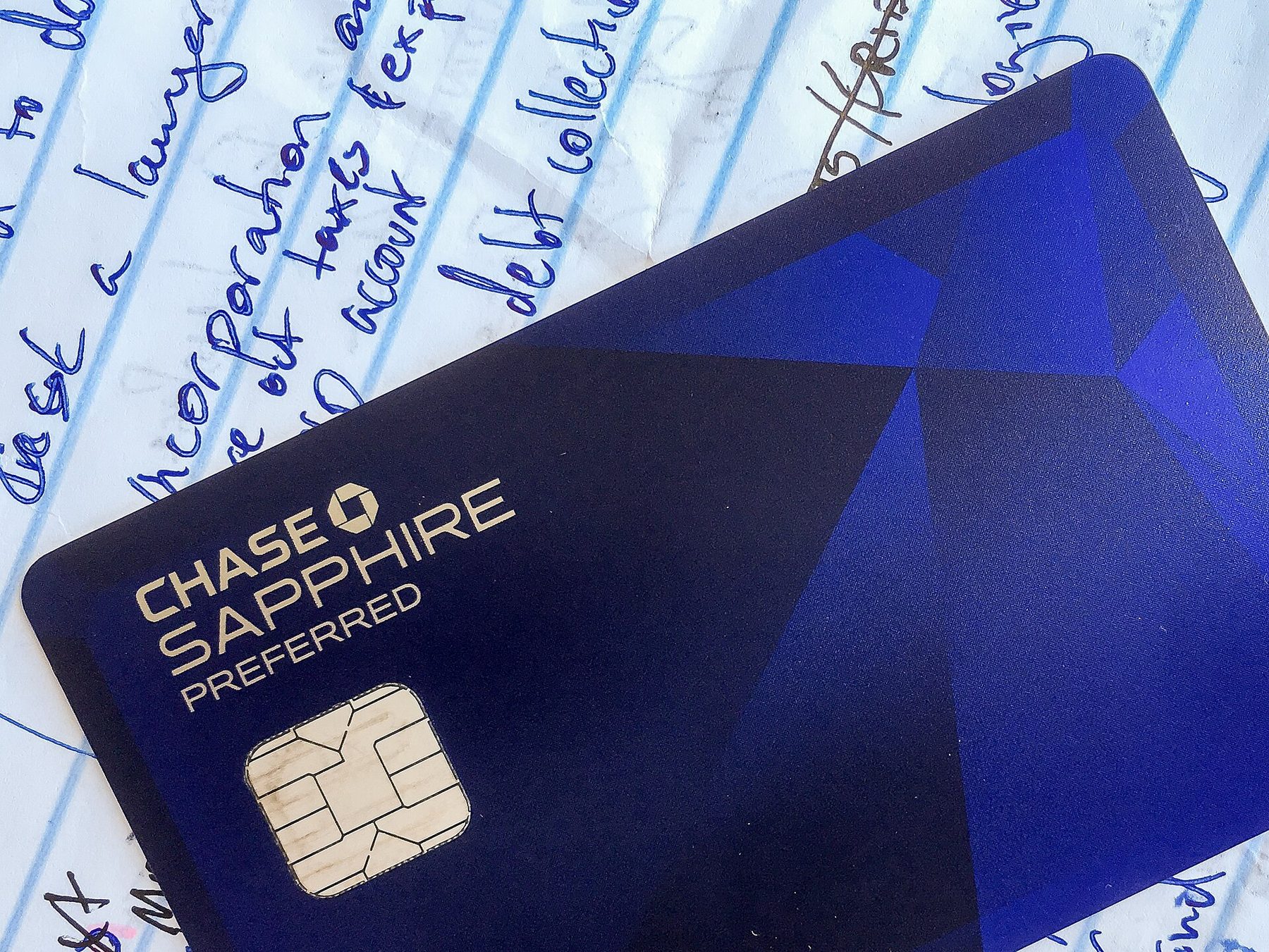
The number that decides whether points pay
A 75,000-point welcome bonus is worth $750 at Chase's own portal rate of a cent a point. 4, 3 Carry a $1,000 balance at the average credit card APR and you hand back the same $750 in interest over about 40.6 months. The bonus arrives once. The interest arrives every statement.
That trade gets settled before any of the interesting parts: the transfer partner, the award chart, the seat at the front of the plane. On 28 September 2026 the Federal Reserve put the average APR on card accounts actually charged interest at 22.15%. 1 A point, by the issuers' own published rates, is worth about a cent. 3, 8, 9 The gap between those two numbers is the whole page.
So the order of operations matters more than the card: clear what is owed before chasing a rate, then let a points strategy start from a balance of zero.
What does carrying a balance actually cost?
The Federal Reserve publishes both halves of the answer: the rate, and the balance a typical cardholder carries.
One line in the Fed's G.19 release settles the argument. In the second quarter of 2026 the average stated APR across all credit card accounts at commercial banks was 20.94%. On the accounts that were actually charged interest, the average was 22.15%. 1 The second figure is the one that belongs beside a real carried balance, because it comes from accounts where interest was really charged.
The balances behind that rate are large. In the Fed's 2025 household survey, cardholders whose answers were matched to credit-bureau records held an average balance of $7,279, up $748 on the same people's balances two years earlier. 2 Nationally, card balances reached $1.263 trillion in the second quarter of 2026, and revolving consumer credit reached $1,357.2 billion in July. 10, 1
| Measure | Figure | As of |
|---|---|---|
| Average APR, all credit card accounts | 20.94% | Q2 2026 (G.19) |
| Average APR, accounts assessed interest | 22.15% | Q2 2026 (G.19) |
| Revolving consumer credit outstanding (USD) | $1,357.2 billion | July 2026, preliminary |
| Total US credit card balances (USD) | $1.263 trillion | Q2 2026 (New York Fed) |
| Card owners who carried a balance in the past year | 45% | 2025 survey |
| Average card balance, matched credit records (USD) | $7,279 | 2025 survey |
The G.19 revolving series is broader than card debt alone, which is why the New York Fed's card-specific total sits lower. The survey balances cover only the 2025 respondents who agreed to have their answers matched to credit-report data.
45% of card owners told the Fed they carried a balance at least once in the previous 12 months, down 12 percentage points over the decade. 2 Close to one in two, then, spent part of the year paying the rate above.
The climb was steepest for the people with the least room. Balances among cardholders who describe themselves as finding it difficult to get by went from $6,735 to $9,265, a rise of $2,530. For those living comfortably, the same two years moved the average $59. 2
What is a travel point actually worth?
About a cent, on the redemption most people reach for. Chase states that points earned on its cards are worth $0.01 each through Chase Travel, and that a Points Boost promotion can lift 100 points to $1.50 on Sapphire Preferred or $2.00 on Sapphire Reserve. 3 The base rate is the one to plan with, because the boost applies per booking.
American Express publishes a table by redemption method: 0.7 to 1 cent for Pay with Points at checkout, up to 1 cent for gift cards, 0.6 cents for covering statement charges, and up to 1 cent for flights booked through Amex Travel. 8
Capital One works its own example on the Venture page: $2,200 of monthly spend earns 52,800 miles a year, which the page calls a $528 value. Divide one by the other and the rate is exactly 1 cent a mile. 9
| Program | Redemption route | Value the issuer states (USD) |
|---|---|---|
| Chase Ultimate Rewards | Chase Travel portal, standard | $0.01 per point |
| Chase Ultimate Rewards | Chase Travel with a Points Boost promotion | up to $0.015 (Sapphire Preferred), up to $0.02 (Sapphire Reserve) |
| Amex Membership Rewards | Pay with Points at checkout | $0.007 to $0.01 per point |
| Amex Membership Rewards | Gift cards | up to $0.01 per point |
| Amex Membership Rewards | Covering charges on the statement | $0.006 per point |
| Amex Membership Rewards | Flights through Amex Travel | up to $0.01 per point |
| Capital One miles | The Venture page's own worked example | 52,800 miles called a $528 value, or $0.01 a mile |
Amex states its figures are approximate and subject to change; its table was last updated on 30 April 2026. Capital One states the miles figure and the dollar figure, and the per-mile rate is the division of the two.
Transfers to an airline or hotel partner can beat a cent, and they can also land below it. Each issuer publishes the transfer ratio and leaves the value to the receiving program's award chart, which moves by route and season, so this page plans with the published portal rates. For a specific flight or hotel night, MMT's points versus cash calculator turns one redemption into a cents-per-point number, and the airline loyalty guide covers the programs those points land in.

Credit card interest vs rewards, on one balance
A worksheet on two published figures: the Fed's average rate and the Fed's average balance.
A year on the average balance costs $1,612.30 in interest and earns $72.79 in points. The inputs are the Fed's 22.15% average APR, the Fed's $7,279 average 2025 balance, and Chase's own cent a point at 1 point per dollar of ordinary spending. 1, 2, 3, 4 The interest comes to 22.15 times the point value.
| Line | Input | Where the input comes from | Result (USD) |
|---|---|---|---|
| Balance carried for the year | $7,279 | Fed 2025 survey, average matched balance | - |
| Rate applied | 22.15% | Fed G.19, accounts assessed interest, Q2 2026 | - |
| Interest for the year | $7,279 x 22.15% | Worksheet arithmetic | $1,612.30 |
| Points earned on the same spend | $7,279 at 1 point per dollar | Sapphire Preferred's 1x base rate | 7,279 points |
| Point value at the portal rate | 7,279 x $0.01 | Chase Travel standard rate | $72.79 |
| Interest as a multiple of the reward | $1,612.30 / $72.79 | Worksheet arithmetic | 22.15 times |
Simple annual interest on a flat balance, and the same dollars counted as both the balance and the spend that earned points. Interest charged daily, as most issuers charge it, would come out higher.
Table view: A year on the average balance: interest against point value
| Item | Value (USD) |
|---|---|
| Interest for the year, at 22.15% | $1,612.30 |
| Point value earned, at a cent a point | $72.79 |
Take the ratio, not the size: the interest is 22.15 times the reward, and it stays 22.15 times at any balance, because both lines move with the same dollars. Worksheet arithmetic on the Fed's published rate and balance and Chase's published point value. Source: 1, 2, 3, 4
How long can a purchase sit before the interest wins?
Sixteen days, at 1 point per dollar. A 22.15% APR works out to about 0.0607% a day, so a purchase carried past about 16 days has cost more in interest than the 1% its points paid. 1, 5 At 2 points per dollar the purchase gets 33 days. At the 5x rate on travel booked through the issuer's portal, 82 days. 4
| Earn rate | Reward on $100 (USD) | Daily interest on $100 (USD) | Days to match the reward |
|---|---|---|---|
| 1x, the base rate on ordinary spending | $1.00 | $0.0607 | 16 days |
| 2x, an everyday 2-mile card | $2.00 | $0.0607 | 33 days |
| 3x, dining and grocery bonus | $3.00 | $0.0607 | 49 days |
| 5x, travel booked through the issuer's portal | $5.00 | $0.0607 | 82 days |
The daily figure divides the 22.15% APR by 365; the CFPB says issuers use 360 or 365, so check the cardholder agreement. Points valued at the Chase Travel standard rate of a cent each.
Table view: One month of interest against the reward it cancels
| Item | Reward earned (USD) | One month of interest (USD) |
|---|---|---|
| 1x, ordinary spending | $10 | $18.46 |
| 2x, everyday miles card | $20 | $18.46 |
| 3x, dining and grocery | $30 | $18.46 |
| 5x, issuer travel portal | $50 | $18.46 |
A 2x card clears a single month of interest by $1.54 and falls behind in the second. Only the bonus categories stay ahead for long, and they cover a narrow slice of a year's spending. Worksheet arithmetic on the Fed's average APR and the issuers' published earn rates and point value. Source: 1, 4, 3, 9
The mechanic behind those days is published. Issuers that charge a daily periodic rate divide the APR by 360 or 365, multiply it by the amount owed at the end of each day, and add the result to the next day's balance, so interest compounds daily. 5
Many issuers apply that rate to the average daily balance across the whole cycle. That is why a payment made mid-cycle lowers the charge on the cycle you are in, instead of waiting for the next one. 11
Are points worth it with a balance on the card?
A welcome bonus is a one-time payment. Interest is a subscription. Chase Sapphire Preferred's current offer is 75,000 points after $5,000 of purchases in the first three months, which is $750 at the portal rate. 4, 3 A $1,000 balance at 22.15% costs $18.46 a month, so about 40.6 months of that interest matches the bonus. Sapphire Reserve's 100,000 points reach $1,000 and buy about 54 months. 3, 1
The spend requirement carries its own bill. Putting $5,000 through the card and carrying it for the three-month window costs about $276.88 in interest at the average rate, which takes a $750 bonus down to roughly $473 before the first award search. 1, 4
- Pay the statement in full and the rewards are yours. A grace period runs from the end of a billing cycle to the payment due date, and clearing the full balance by that date keeps that period's purchases free of interest on most cards. 6
- Issuers must mail or deliver the bill at least 21 days before the payment is due, so the grace period holds even when a payment lands late in the window. 6
- Any payment above the minimum goes to the highest-APR balance first, by law, which matters on a card carrying a promotional transfer rate alongside new purchases. 11
- Every statement shows how long minimum payments alone would take to clear the balance, and the monthly payment that clears it in 36 months. Read that box before reading a welcome offer. 12
Put the rewards back in the plan, in this order
The rate comes first, the card second. Four steps, each one a thing to do this week, and none of them requires giving up the trip the points are for.
Read your own APR and balance off the statement
A card's interest rate is stated as a yearly rate, the APR, and yours sits on the statement beside the balance it applies to. 7 Those two numbers replace the averages on this page.
Then go shopping for points
With the balance at zero each month, a 1x card pays 1% and a 5x travel portal pays 5%, with all of it kept. Start at MMT's credit card points hub for the fees and transfer partners, and check what a foreign transaction fee does to the same spending abroad. 4, 3
A cardholder who pays in full earns the same 75,000 points as everyone else, on the same welcome offer, and keeps all $750 of it. 4, 3 That is the version of this game worth playing, and the rate on your statement is the scoreboard.
Frequently asked questions
Are travel points worth it if I carry a balance?
The arithmetic goes against it. The average APR on accounts actually charged interest was 22.15% in the second quarter of 2026, and the most common redemption values a point at a cent, so every dollar carried for a year costs about 22 cents while a dollar of ordinary spending earns one. 1, 3 Clear the balance first, then the same card pays the same points. 6
Is my card's rate fixed, or does it move?
Almost certainly variable. The CFPB defines a fixed APR as one that does not move with an index, and a variable APR as one that tracks an index such as the prime rate published in the Wall Street Journal, with the cardholder agreement stating which kind is on the account and how it can change. 16 Every named-card range on this page is a variable APR, so a change in the prime rate reaches the statement too.
What is the 36-month box on my statement telling me?
Two numbers federal law requires: how long the balance would take to clear paying only the minimum, and the flat monthly payment that would clear it in 36 months instead. 12 Both figures ignore any new purchases charged to the card after the statement date, so they understate the payoff time on an account still in use.
What is one point or mile actually worth?
A cent is the planning figure. Amex publishes 0.6 to 1 cent depending on the redemption method. 8 Capital One's own Venture example values 52,800 miles at $528, exactly a cent each. 9
Does paying in the middle of the billing cycle help?
Yes, on any card that charges interest on the average daily balance. Many issuers calculate interest that way, so a payment made partway through the cycle lowers the daily balance for the remaining days and cuts what is charged at the end of that cycle, instead of waiting for the next one to show the benefit. 11
Should I pay off my card before applying for a travel card?
That order pays better. With the statement cleared each month the grace period keeps purchases free of interest on most cards, so a 1x card pays a clean 1% and a 5x portal booking pays 5%. 6, 4 Any payment above the minimum goes to your highest-APR balance first, which is the fastest legal route to that point. 11
Where do I find the average credit card APR, and does my card match it?
The Federal Reserve publishes it quarterly in the G.19 release: 20.94% across all accounts and 22.15% on accounts assessed interest for the second quarter of 2026. 1 Published card ranges straddle it, from 18.24% to 28.74% across three cards checked on 28 September 2026, and all three are variable. 13, 14, 15, 16
How many people are carrying a balance on a rewards card?
45% of card owners told the Fed's 2025 survey they carried a balance at least once in the previous year, and 82% of adults had a card. 2 Total US card balances reached $1.263 trillion in the second quarter of 2026. 10 The average balance among matched survey respondents rose $748 in two years, to $7,279. 2
Sources & review date
Researched 2026-09-28. Every rate, balance and point value here was read on 28 September 2026 from the Federal Reserve, the Consumer Financial Protection Bureau or the card issuer's own page. Three figures are worksheet arithmetic on those published inputs, labeled where they appear: a year of interest against a year of point value, the days a purchase can sit before interest matches its reward, and the months of interest that match a welcome bonus. Each uses simple interest on a flat balance, so daily compounding would raise the interest cost, not lower it.
- 1G.19 Consumer Credit: Terms of Credit and Consumer Credit Outstanding Federal Reserve Board · Accessed 2026-09-28 · Primary source
- 2Economic Well-Being of U.S. Households in 2025: Credit Federal Reserve Board · Accessed 2026-09-28 · Primary source
- 3Chase Sapphire Reserve: rewards, point value and welcome bonus Chase · Accessed 2026-09-28 · Primary source
- 4Chase Sapphire Preferred: earn rates and welcome bonus Chase · Accessed 2026-09-28 · Primary source
- 5What is a daily periodic rate on a credit card? Consumer Financial Protection Bureau · Accessed 2026-09-28 · Primary source
- 6What is a grace period for a credit card? Consumer Financial Protection Bureau · Accessed 2026-09-28 · Primary source
- 7What is a credit card interest rate? What does APR mean? Consumer Financial Protection Bureau · Accessed 2026-09-28 · Primary source
- 8How much are Membership Rewards points worth? American Express · Accessed 2026-09-28 · Primary source
- 9Capital One Venture Rewards Credit Card Capital One · Accessed 2026-09-28 · Primary source
- 10Household Debt and Credit Report, Q2 2026 Federal Reserve Bank of New York · Accessed 2026-09-28 · Primary source
- 11How does my credit card company calculate the amount of interest I owe? Consumer Financial Protection Bureau · Accessed 2026-09-28 · Primary source
- 12The 36-month payoff box on a credit card statement Consumer Financial Protection Bureau · Accessed 2026-09-28 · Primary source
- 13Citi Double Cash Credit Card Citi · Accessed 2026-09-28 · Primary source
- 14Chase Freedom Unlimited Chase · Accessed 2026-09-28 · Primary source
- 15Discover it Cash Back Discover · Accessed 2026-09-28 · Primary source
- 16What is the difference between a fixed APR and a variable APR? Consumer Financial Protection Bureau · Accessed 2026-09-28 · Primary source