Start with the raft
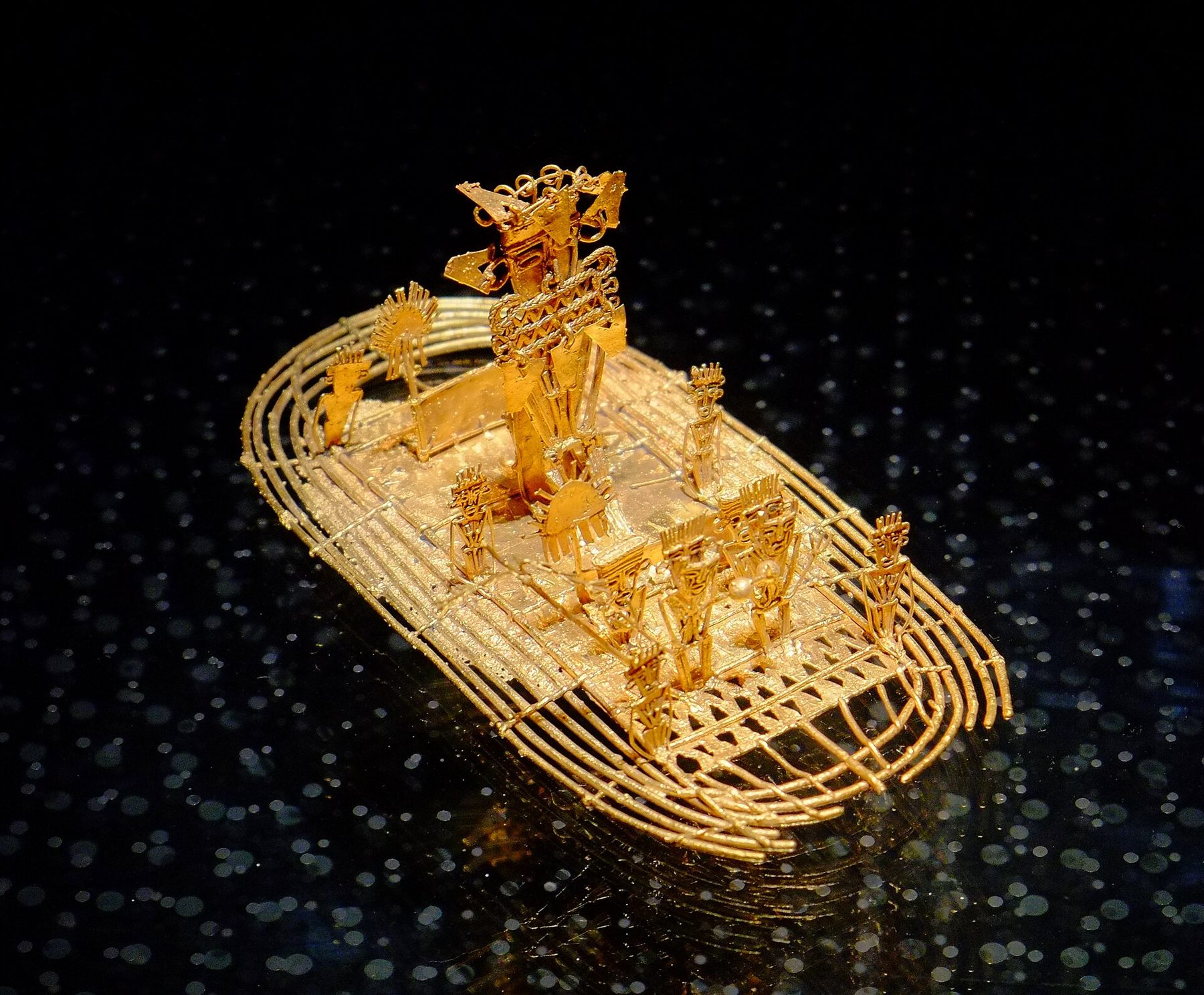
A small gold raft sits alone in a lit case, and a crew of figures rides it. The one at the center stands taller than the rest. The Museo del Oro's own account traces the piece to a cave near Pasca, Cundinamarca, where a campesino named Cruz María Dimaté found it in 1969. Banco de la República bought it for the museum that same year. Europe turned the ceremony it shows into the legend of El Dorado. 9
Since 20 December 2024 the raft has shared its case with the rest of that find. An offering vessel shaped like a seated person. A small ceramic lime container. Fragments of a feline skull. A second gold figure, a chieftain carried aloft in a litter. The museum put the whole offering back together for the first time in that renovation, 55 years after it came out of the ground. 1
The collection around it began in 1939, 87 years ago. Four halls hold it and you can take them in any order: the working of metals, the people and gold of pre-Hispanic Colombia, cosmology and symbolism, and the offering. The objects span 2,500 years, made by societies living across what is now Colombia long before the European conquest. 10
Bogotá sits at the top of most Colombia itineraries because of this one building. If the museums are why you are stopping, give them two mornings, and read the one month in Colombia route for where the rest of the trip goes.
What does a Museo del Oro ticket cost?
Four prices, one free day a week, and an audio guide that is the only extra the museum sells.
A foreign adult pays COP 21,000, about USD 6.35 at the 27 September 2026 rate. A Colombian citizen or a resident foreigner pays COP 10,000, roughly USD 3.02. Students pay COP 5,000. Then Sunday arrives and the whole tariff stands down: entry is free for everyone, with no residency test and no paperwork at the desk. 2, 3
| Visitor | Tuesday to Saturday and holidays (COP) | Approx. USD | Sunday (COP) |
|---|---|---|---|
| Foreign visitor | 21,000 | 6.35 | 0 |
| Colombian citizen or resident foreigner | 10,000 | 3.02 | 0 |
| Student | 5,000 | 1.51 | 0 |
| Under 12, over 62, Indigenous visitors, people with disabilities | 0 | 0.00 | 0 |
| Audio guide rental (any day) | 8,000 | 2.42 | 8,000 |
Hours are Tuesday to Saturday 9 a.m. to 7 p.m., last entry 6 p.m., and Sunday and holidays 10 a.m. to 5 p.m., last entry 4 p.m. Closed Mondays, holiday Mondays included. The museum stands on Parque de Santander, at Carrera 6a and Calle 16. Dollar figures use Colombia's official market rate of COP 3,306.86 to USD 1, valid 26 to 28 September 2026.
Which Bogotá museums are free every day?
Three of them, one block apart in La Candelaria, run by the central bank.
Banco de la República runs three museums within a block of each other, and all three are free. The Museo Botero at Calle 11 No. 4-41, the Museo Casa de Moneda at Calle 11 # 4-93, and the Museo de Arte Miguel Urrutia at Calle 11 # 4-21. The bank's own page for the complex invites you to take in five centuries of art at no charge. 4, 5, 6
The Botero Museum
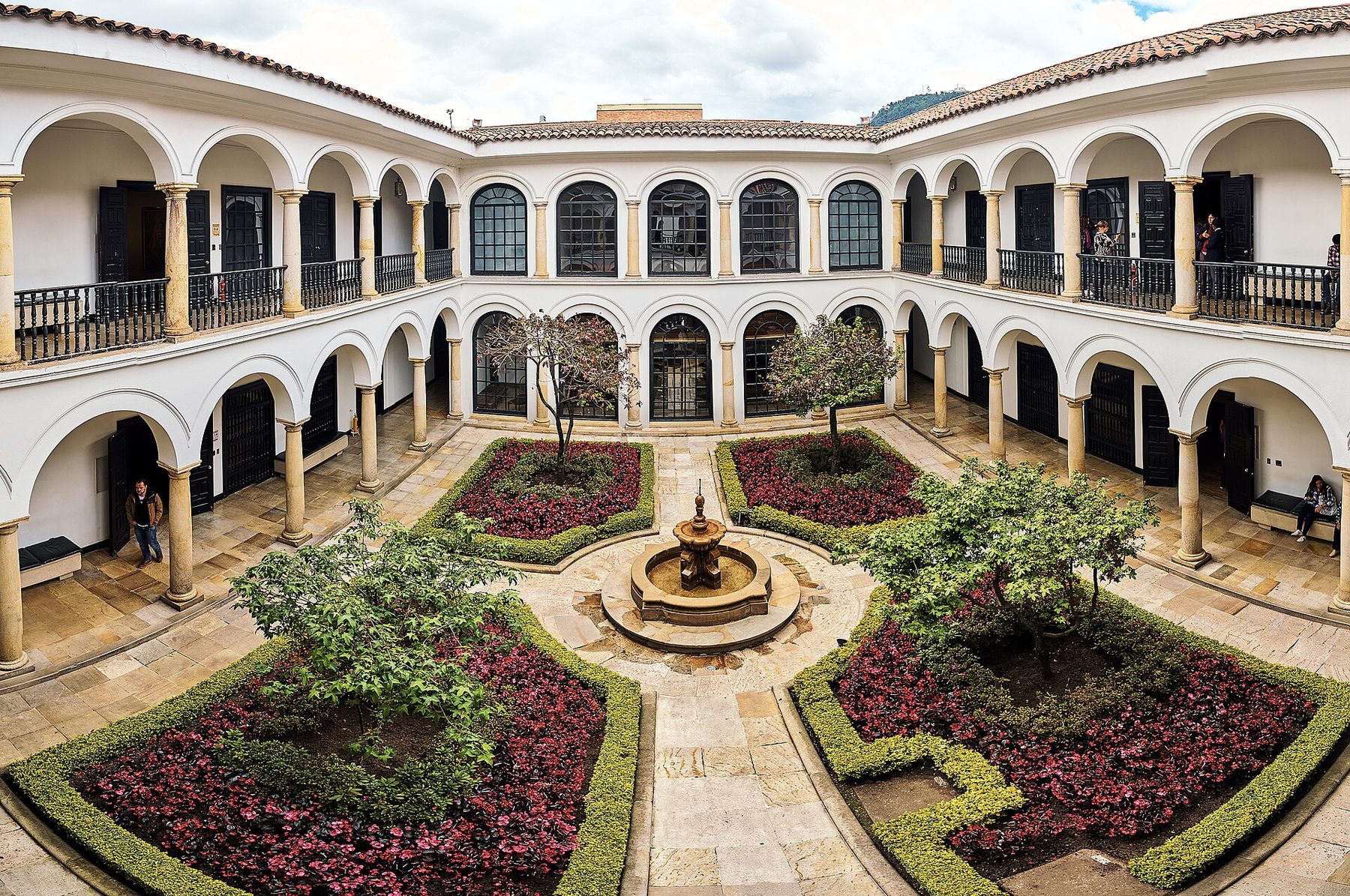
Fernando Botero handed 208 works to the bank in 2000: 123 of his own and 85 by other international artists he had collected. They hang in a colonial house around a courtyard, on the same morning's walk as the gold, and the ticket price is zero. 11, 4
| Museum | Address | Monday | Tuesday | Wednesday to Saturday | Sunday and holidays |
|---|---|---|---|---|---|
| Museo Botero | Calle 11 No. 4-41 | 9 a.m. to 7 p.m. | Closed | 9 a.m. to 7 p.m. | 10 a.m. to 5 p.m. |
| Museo Casa de Moneda | Calle 11 # 4-93 | 9 a.m. to 7 p.m. | Closed | 9 a.m. to 7 p.m. | 10 a.m. to 5 p.m. |
| Museo de Arte Miguel Urrutia | Calle 11 # 4-21 | 9 a.m. to 7 p.m. | Closed | 9 a.m. to 7 p.m. | 10 a.m. to 5 p.m. |
All three are free, every day they open. Last entry is one hour before closing, and the bank notes that hours can change without notice. MAMU's collection comes from the bank's wider art holdings, started in 1957.
Museo Nacional: two prices and a cash-only door
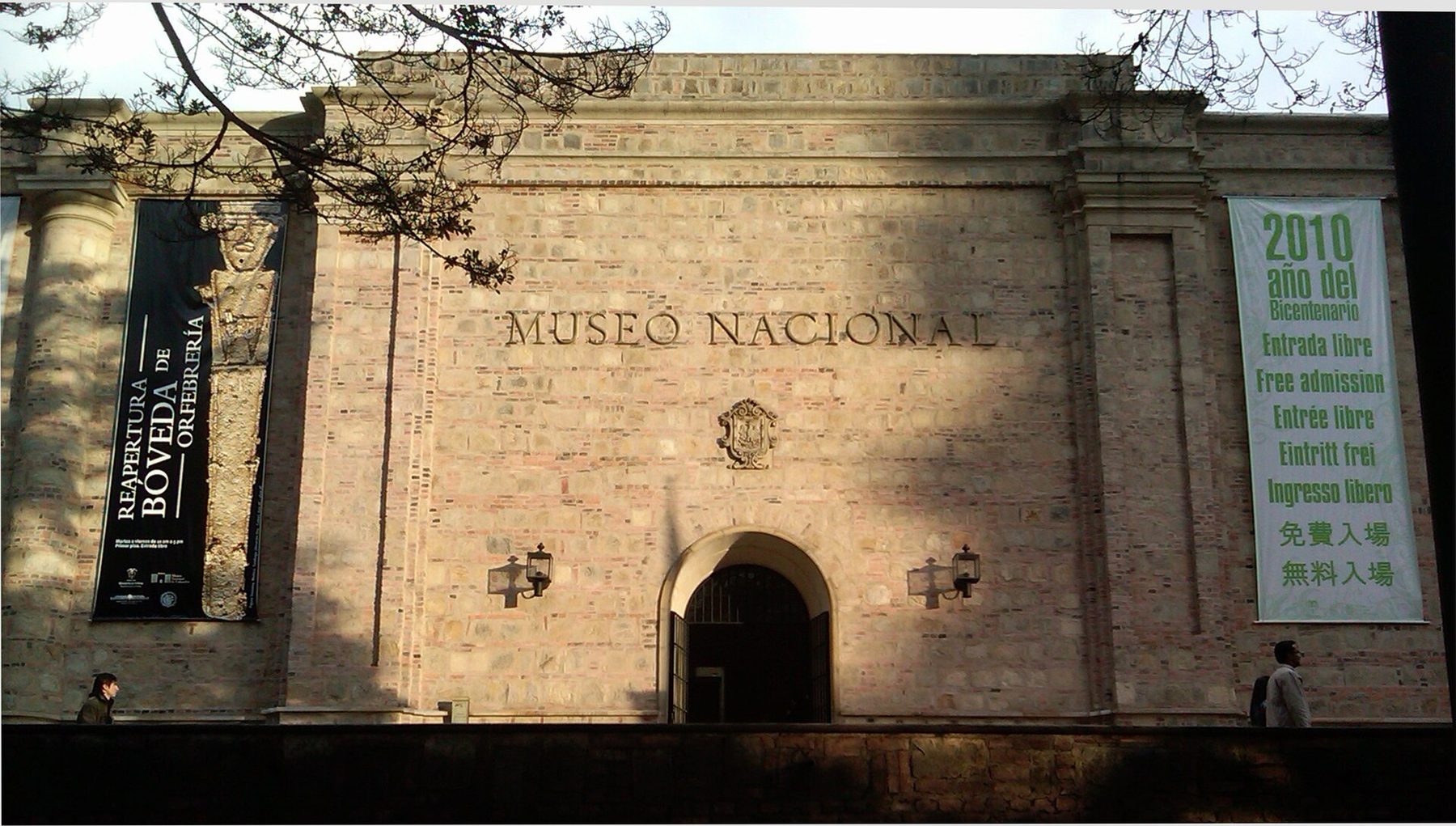
A foreign adult pays COP 15,000 here and a Colombian adult pays COP 6,000, both plus a voluntary contribution, under Resolución No. 2137 de 2025. That gap is 2.5 times. Bring pesos: the door takes Colombian currency in cash, with no cards and no dollars, which catches out people who arrived by taxi on a card. 7
| Visitor | Colombian or resident (COP) | Foreign tourist (COP) | Foreign tourist, approx. USD |
|---|---|---|---|
| Child, 6 to 12 | 2,000 | 5,000 | 1.51 |
| Youth, 13 to 17 | 4,000 | 10,000 | 3.02 |
| Adult, 18 to 59 | 6,000 | 15,000 | 4.54 |
| Under 5 and over 60 | 0 | 0 | 0.00 |
Every paid price carries a voluntary contribution on top, and one ticket covers the permanent and temporary halls. Hours are Tuesday to Friday 9 a.m. to 5 p.m. and Saturday and Sunday 10 a.m. to 5 p.m. Closed every Monday, holiday Mondays included, for cleaning and maintenance, and from 1 p.m. on 24 and 31 December. Dollar figures at COP 3,306.86 to USD 1.
The free windows here are narrower than the Museo del Oro's, and worth writing down. Wednesday afternoons, 2 p.m. to 5 p.m. The last Sunday of every month. Then three fixed dates a year: 20 July, 7 August and 12 October. Those are the museum's own published hours, and they apply to the exhibition halls. 7
Table view: What a resident pays, and what a visitor pays
| Item | Colombian national (COP) | Foreigner (COP) |
|---|---|---|
| Museo del Oro, Tuesday to Saturday | 10,000 COP | 21,000 COP |
| Museo Nacional de Colombia, adult | 6,000 COP | 15,000 COP |
| MAMBO, adult | 21,000 COP | 30,000 COP |
The Museo Nacional runs the widest gap, at 2.5 times the resident price. MAMBO runs the narrowest, at 1.43 times, and the highest bill either way. Sunday drops the Museo del Oro row to zero for both groups. MAMBO does not publish a resident rate; a foreign resident may pay its COP 30,000 visitor price rather than the COP 21,000 shown here for Colombian nationals. Source: 2, 7, 8
MAMBO and Fragmentos: one ticket, one open door
MAMBO is the one museum on this page that charges every day it opens. It is an independent foundation, outside the central bank's free network, and the prices show it: COP 30,000 for a foreign visitor, COP 21,000 for the general public, COP 15,000 for students, teachers with a valid card and anyone over 60. Children under five, Amigo MAMBO members and people with disabilities enter free. 8
The doors open Tuesday to Saturday, 10 a.m. to 6 p.m. with last entry at 5:15 p.m., and Sunday and holidays from noon to 5 p.m. with last entry at 4:15 p.m. Closed Mondays, at Calle 24 #6-00. One local rule catches visitors out: when a holiday falls on a Monday, MAMBO closes the Tuesday after it as well. 8
Fragmentos costs nothing, and its floor is made of melted weapons. Doris Salcedo built the space from arms the FARC surrendered, and the Museo Nacional runs it. Open Tuesday to Sunday, 9 a.m. to 5 p.m., at Carrera 7 # 6B-30. It closes on Mondays and on 1 January, 1 May and 25 December. 12
Is Sunday really the free museum day in Bogotá?
Two different free-day policies, often blurred into one. Here is which is which.
Sunday is free at the Museo del Oro every week of the year. At the Museo Nacional, Sunday is free only on the last one of the month. Those are two policies from two institutions, and roundups tend to merge them. The three museums on the Banco de la República block are free on a Sunday for the same reason they are free on a Thursday: they are free. 2, 7, 4, 5, 6
| Day | Museo del Oro | The free block, 3 museums | Museo Nacional | Fragmentos | MAMBO |
|---|---|---|---|---|---|
| Monday | Closed | Open, free | Closed | Closed | Closed |
| Tuesday | COP 21,000 | Closed | COP 15,000 | Free | COP 30,000 |
| Wednesday | COP 21,000 | Open, free | Free 2 to 5 p.m., else COP 15,000 | Free | COP 30,000 |
| Thursday and Friday | COP 21,000 | Open, free | COP 15,000 | Free | COP 30,000 |
| Saturday | COP 21,000 | Open, free | COP 15,000 | Free | COP 30,000 |
| Sunday | Free | Open, free | Free on the last Sunday, else COP 15,000 | Free | COP 30,000 |
Prices shown are the foreign-adult rate. Colombian citizens and resident foreigners pay less at the Museo del Oro and the Museo Nacional; MAMBO does not publish a resident rate and may charge foreign residents its COP 30,000 foreign-visitor price. Holidays follow Sunday opening hours at the Museo del Oro and at the free block, but not Sunday prices: a foreign adult still pays COP 21,000 at the Museo del Oro on a holiday. The free block is free on holidays as on every day it opens. The Museo Nacional adds three free dates a year: 20 July, 7 August and 12 October.
Table view: One foreign adult, the same seven museums, four different bills
| Item | Value (COP) |
|---|---|
| Thursday, all seven | 66,000 COP |
| Any Sunday, all seven | 45,000 COP |
| Last Sunday of the month, all seven | 30,000 COP |
| Last Sunday, the six museums that go free | 0 COP |
The whole difference is MAMBO and the calendar. On the last Sunday of a month the Museo del Oro, the three museums of the free block, Fragmentos and the Museo Nacional all cost zero. Only MAMBO's COP 30,000 survives every day of the week. Source: 2, 4, 5, 6, 7, 12, 8
COP 66,000 is about USD 19.96, and COP 30,000 is a decision rather than luck. More than half the saving, COP 36,000, comes from the Museo del Oro and the Museo Nacional, taken on the last Sunday of a month. Colombian citizens pay less too: MAMBO's COP 21,000 national rate would bring the round to COP 37,000, about USD 11.19, but MAMBO does not confirm that rate for foreign residents, who may pay its COP 30,000 visitor price instead. 2, 7, 8, 3
The Muisca today, and what the museums say about them
The Muisca are a governing community in Bogotá right now, and their numbers are published. The Cabildo Indígena Muisca de Suba describes itself as the Muysca community of Suba, holding that territory since before Gonzalo Jiménez de Quesada arrived in 1537. The national and district government ratified the Cabildo on 25 January 1991. Its own 2023 census counts 3,481 families and 10,341 people. 13
Suba is a locality inside the city. Keep it apart from the gold in the display cases. The Museo del Oro's four halls present archaeology, made by societies across what is now Colombia over 2,500 years; the Cabildo is a government with a census three years old. Both are true at once, and the page that blurs them tells you less about either. 10, 13
Every museum on this page with a ticket desk admits several communities free, every day of the week. The fullest list is the Museo Nacional's own published policy, and it reaches Fragmentos, which the Museo Nacional runs. 7, 12
- Members of Indigenous communities and resguardos, registered in the Interior Ministry's self-census. 7
- Members of Black, Afro-Colombian, Raizal and Palenquero communities, registered in the same self-census. 7
- People with a disability plus one companion, children under five, and adults over 60. 7
- Beneficiaries of Generación E, Ingreso Solidario, Familias en Acción and Jóvenes en Acción, along with accredited ICOM members and Ministry of Culture staff. 7
- At the Museo del Oro the free list is shorter and runs every day: Indigenous visitors, under-12s, over-62s and people with disabilities, with certification at the desk. 2
One thing the museums publish, and one thing they leave open. The 2024 Balsa Muisca renovation was credited to specialists in pre-Hispanic goldsmithing, conservation, architecture and design. No page from either museum names a present-day Muisca government as a partner in how these objects are shown. Ask at the desk if that matters to your visit. 1
How should you order a museum day in Bogotá?
Pick the day first, then the walk. Two mornings cover everything on this page, and the order depends entirely on which days of the week you hold in the city.
Walk north to the gold
The Museo del Oro stands on Parque de Santander, Carrera 6a at Calle 16. Last entry is 6 p.m. Tuesday to Saturday and 4 p.m. on Sunday, so give yourself a clear two hours ahead of those cutoffs. 2
Carry cash pesos for the Museo Nacional
Its door takes Colombian pesos in cash. Draw the money before you go, and check what your own bank charges for it with the ATM fees comparison. Keep small notes for the voluntary contribution too. 7
Save MAMBO for a paying day
MAMBO charges a foreign visitor COP 30,000 whichever day you arrive, so it costs the same on a Thursday as on a free Sunday. Spend the free Sunday at the museums that give it away, and buy MAMBO midweek. 8
Museums are one line in a Bogotá budget. The rest of the country's costs sit in the Colombia travel guides, the coffee region has its own Salento and Cocora Valley guide, and if a laptop is coming with you, the remote-work travel budget prices the desk and the data.
Frequently asked questions
Do I need to book Museo del Oro tickets in advance?
No reservation is required. The museum's own visitor page tells you to plan the visit and turn up, and you buy at the door in pesos by cash, debit or credit. On Sunday the ticket still gets issued, at zero. Free guided tours run Tuesday to Saturday with no booking, and the times go up at the entrance. 2
Are Bogotá's museums free on public holidays?
Not automatically. The Museo del Oro opens holiday hours like a Sunday, 10 a.m. to 5 p.m., but still charges a foreign adult COP 21,000; only the calendar Sunday is free there. The three Banco de la República museums on Calle 11 are free on a holiday as on every day they open. The Museo del Oro, the Museo Nacional, Fragmentos and MAMBO all close on a holiday that falls on a Monday, and MAMBO closes the following Tuesday too. The Museo Nacional adds three fixed free dates a year: 20 July, 7 August and 12 October. 2, 4, 5, 6, 7, 12, 8
How much is the Botero Museum, and what hangs in it?
Free, every day it opens. Fernando Botero gave 208 works to Banco de la República in 2000: 123 of his own and 85 by other international artists from his private collection. It opens Monday and Wednesday to Saturday, 9 a.m. to 7 p.m., and Sunday and holidays 10 a.m. to 5 p.m., at Calle 11 No. 4-41. Tuesday is its closed day. 4, 11
What happens if I turn up on a Monday?
You get the free block and little else. The Museo Botero, the Museo Casa de Moneda and MAMU open 9 a.m. to 7 p.m. The Museo del Oro, the Museo Nacional, Fragmentos and MAMBO all close on Mondays, holiday Mondays included. MAMBO adds a rule of its own: a Monday holiday closes it the following Tuesday as well. 4, 5, 6, 2, 7, 12, 8
Can I pay museum entry with a card?
At the Museo del Oro, yes: cash, debit or credit in pesos at the desk. At the Museo Nacional, no. Its door takes Colombian pesos in cash, with no cards and no dollars. Carry small notes for both, and for the voluntary contribution the Museo Nacional adds on top of every paid ticket. 2, 7
Is the Museo Nacional worth COP 15,000 as a foreign visitor?
About USD 4.54 buys the permanent halls and whatever temporary show is running, on one ticket. If the number bothers you, the museum hands the same access over free on Wednesdays from 2 p.m. to 5 p.m., on the last Sunday of each month, and on 20 July, 7 August and 12 October. 7, 3
Are there Muisca communities in Bogotá today?
Yes. The Cabildo Indígena Muisca de Suba is a self-governing community inside the city, ratified by the national and district government on 25 January 1991, counting 3,481 families and 10,341 people in its own 2023 census. Its website sets out that history in the community's own words, under the name Muysca. 13
Is there one pass that covers all of Bogotá's museums?
None of the museums on this page points to a shared pass or circuit ticket on its own site, and each one sets its own free days. Plan around the free days instead. On the last Sunday of a month they take a COP 66,000 foreign-adult round down to the COP 30,000 that MAMBO charges every day. 2, 7, 8, 4, 3
Sources & review date
Researched 2026-09-27. Prepared from primary sources, with a separate independent source review. Numbered notes in the text point to the sources below. Prices, entry rules and schedules change; use the linked authority for your dates.
- 1The Muisca Raft: an offering for the care of the world (renovated exhibit, 20 December 2024) Banco de la República, Museo del Oro · Accessed 2026-09-27 · Primary source
- 2Museo del Oro: programa tu visita (hours, admission, audio guide, address) Banco de la República, Red Cultural · Accessed 2026-09-26 · Primary source
- 3Tasa Representativa del Mercado, COP 3,306.86 per USD 1, valid 26 to 28 September 2026 Superintendencia Financiera de Colombia, via datos.gov.co · Accessed 2026-09-26 · Primary source
- 4Museo Botero: entrada gratuita, horarios y ubicación Banco de la República, Museo Botero · Accessed 2026-09-27 · Primary source
- 5Museo Casa de Moneda: horarios y ubicación Banco de la República, Museo Casa de Moneda · Accessed 2026-09-27 · Primary source
- 6Museo de Arte Miguel Urrutia: the three-museum cultural block Banco de la República, MAMU · Accessed 2026-09-27 · Primary source
- 7Museo Nacional de Colombia: horarios, tarifas y entrada libre Museo Nacional de Colombia · Accessed 2026-09-27 · Primary source
- 8MAMBO: visítanos (tarifas y horarios) Museo de Arte Moderno de Bogotá · Accessed 2026-09-27 · Primary source
- 9La Balsa Muisca y El Dorado Banco de la República, Museo del Oro · Accessed 2026-09-26 · Primary source
- 10Exposición permanente del Museo del Oro: the four halls and the 1939 collection Banco de la República, Museo del Oro · Accessed 2026-09-27 · Primary source
- 11Museo Botero: acerca de (208 works donated in 2000) Banco de la República, Museo Botero · Accessed 2026-09-27 · Primary source
- 12Fragmentos, Espacio de Arte y Memoria: entrada gratuita y horarios Fragmentos, Espacio de Arte y Memoria · Accessed 2026-09-27 · Primary source
- 13Somos: la comunidad Muysca de Suba Cabildo Indígena Muisca de Suba · Accessed 2026-09-26 · Primary source