The current does the swimming
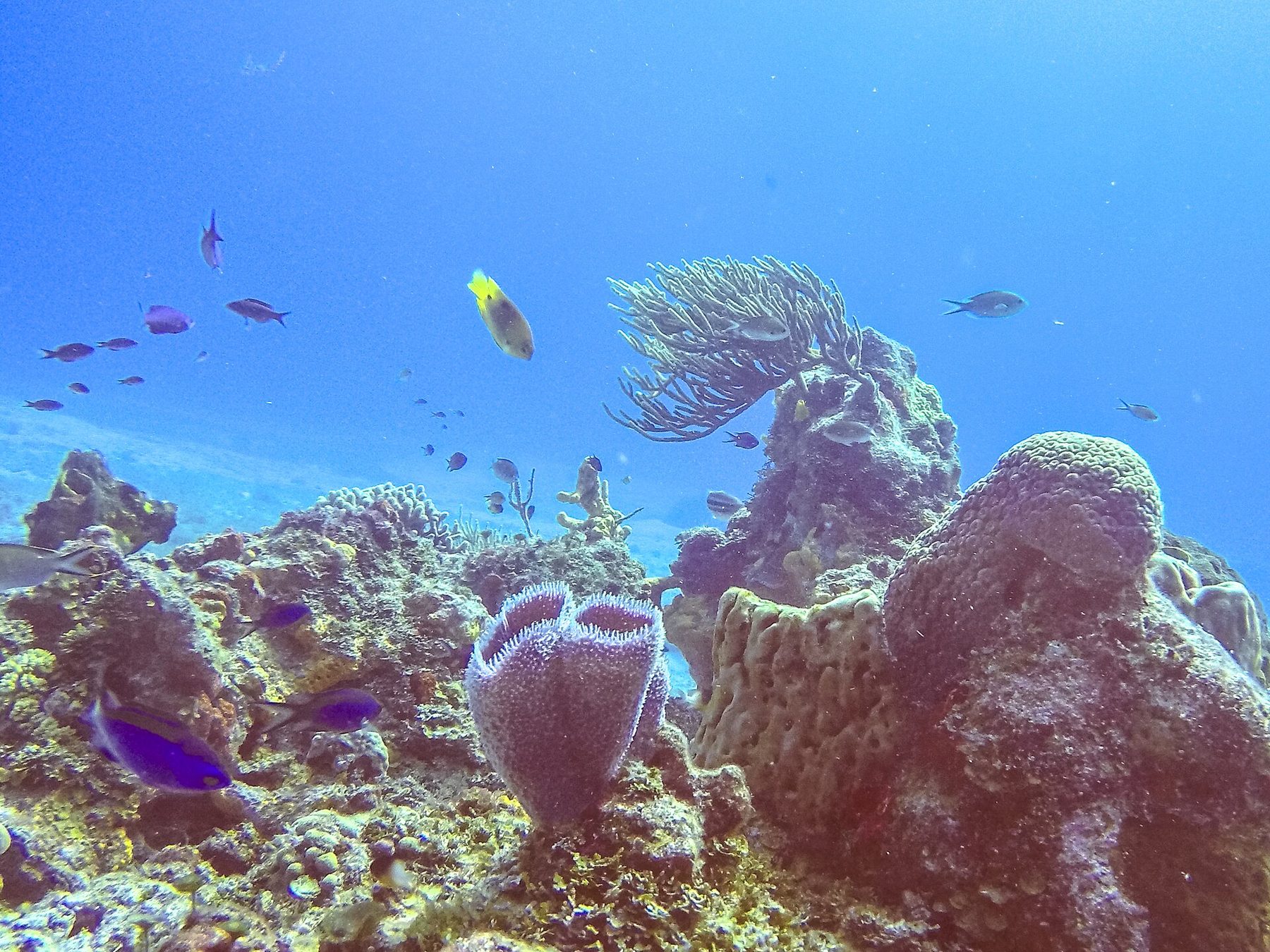
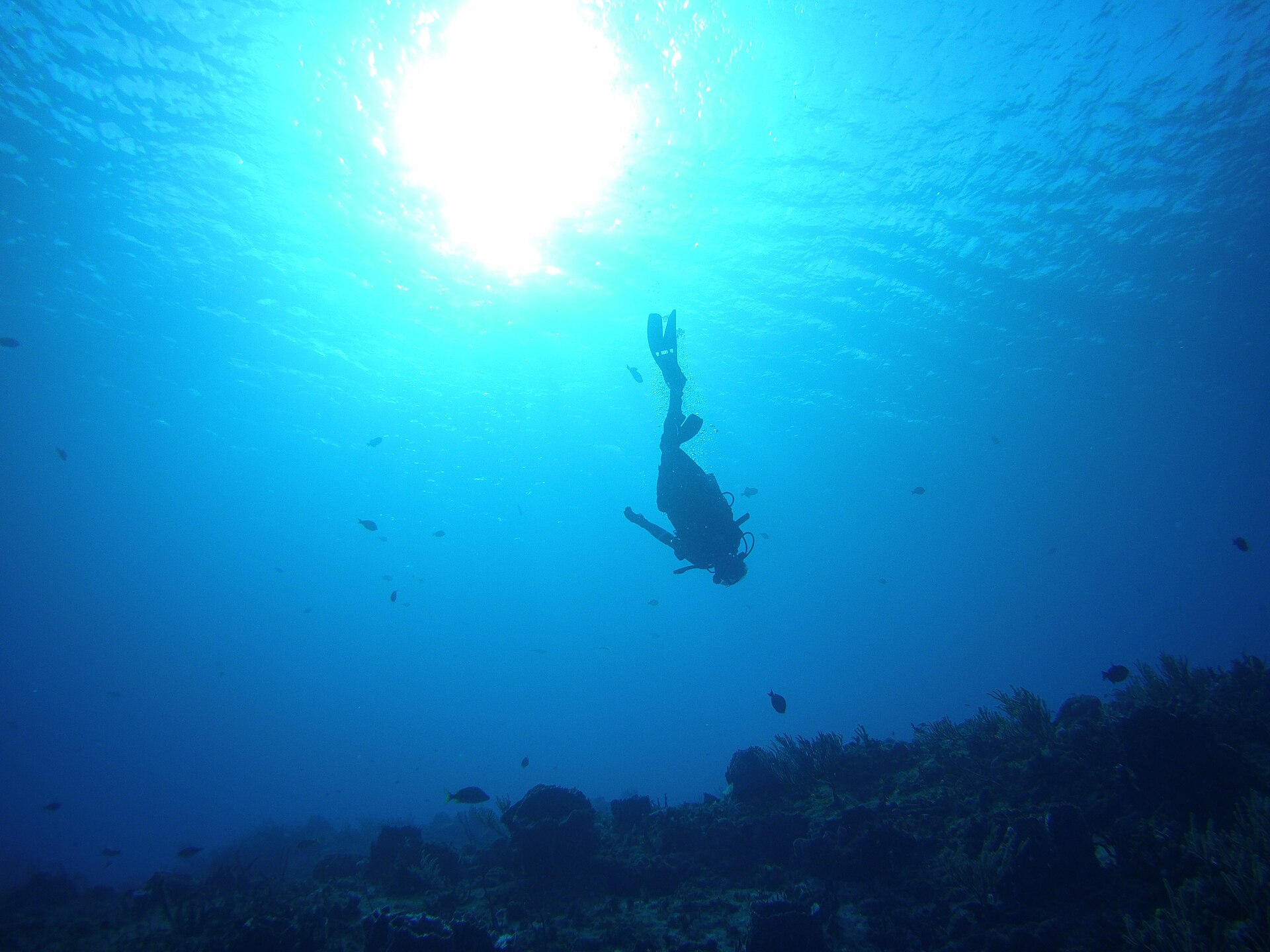
You roll off the boat and the island starts to move past you. Cozumel is drift diving almost everywhere, and the Yucatan Current does the work. Pelagic Ventures puts that current at an average of 1 to 2 knots at most standard sites, and considerably faster on strong-current days at exposed sites. You hang in the water column. The reef scrolls by. 2
The water is warm and clear enough to make the whole thing feel easy. The same operator gives 80 to 150 feet of visibility and 75 to 84 degrees F year-round. Blue Note Scuba's per-site figures run narrower, mostly 80 to 100 feet. Both are the shops' own descriptions of their own reefs. 2, 1
Every site below sits inside one national park. Arrecifes de Cozumel covers 11,987.88 hectares in the municipality of Cozumel, Quintana Roo, and all but 82.28 of those hectares are sea. Mexico decreed it on 19 July 1996, and the national protected areas commission, CONANP, runs it. That single boundary is why a fee follows you onto every boat. 7
Palancar: four dives wearing one name
Palancar is four dive sites sharing a single name. Gardens, Horseshoe, Caves and Bricks run along about three miles of reef off Cozumel's southwest coast, and the current usually sets south to north across all of them. Book Palancar twice in a week and you can get two dives that share little but the name. 1
| Section | Level | Depth (ft) | Depth (m) | What the dive is |
|---|---|---|---|---|
| Palancar Gardens | Beginner | 30-80 | 9-25 | Coral heads and sand with turtles, eagle rays, jacks and blue tangs, on a mild current |
| Palancar Horseshoe | Intermediate | 30-90 | 9-28 | A horseshoe amphitheater of coral on a wall steep enough to want good buoyancy |
| Palancar Caves | Intermediate | 40-130 | 12-40 | Massive coral pinnacles cut by a maze of swim-throughs facing open water |
| Palancar Bricks | Intermediate | 40-130 | 12-40 | Tall pinnacles and sandy slopes, with eagle rays, reef sharks and barracuda |
Depths and level tags are Blue Note Scuba's own per-site entries, read on 25 September 2026. A summary table on the same page gives narrower bands for all four and rates Palancar Caves Advanced at 60-90 ft, so read the level as a guide and the depth as the range the dive can use. 1
The Caves entry is where the operator argues with itself. Its detailed write-up calls the site Intermediate and 40 to 130 feet. Its own summary table, on the same page, calls it Advanced and 60 to 90 feet. Read both, tell the shop your logged-dive count, and let the guide place you. 1
Columbia: pinnacles at 130 feet, a garden at 25
Columbia Deep is the dive people fly in for. Blue Note Scuba rates it Advanced, 60 to 130 feet, and describes towering coral pinnacles split by sand chutes that pour into open water, with swim-throughs and soft coral sponges between them. Blue Note Scuba calls it one of the top dive sites in the world. 1
Columbia Shallow is the same name at a quarter of the depth. Beginner, 20 to 30 feet, mild current, and most of the island's tropical fish in one place. It works as a second tank after the deep dive, and it is the better of the two for a camera. 1
Pelagic Ventures spells the site Colombia and draws the line in a different place. It asks for Advanced Open Water on the deeper sections and treats the shallows as an Open Water drift. Same reef, two operators, two answers. Ask which one your shop is running. 2
Santa Rosa Wall and Punta Sur: the deep end
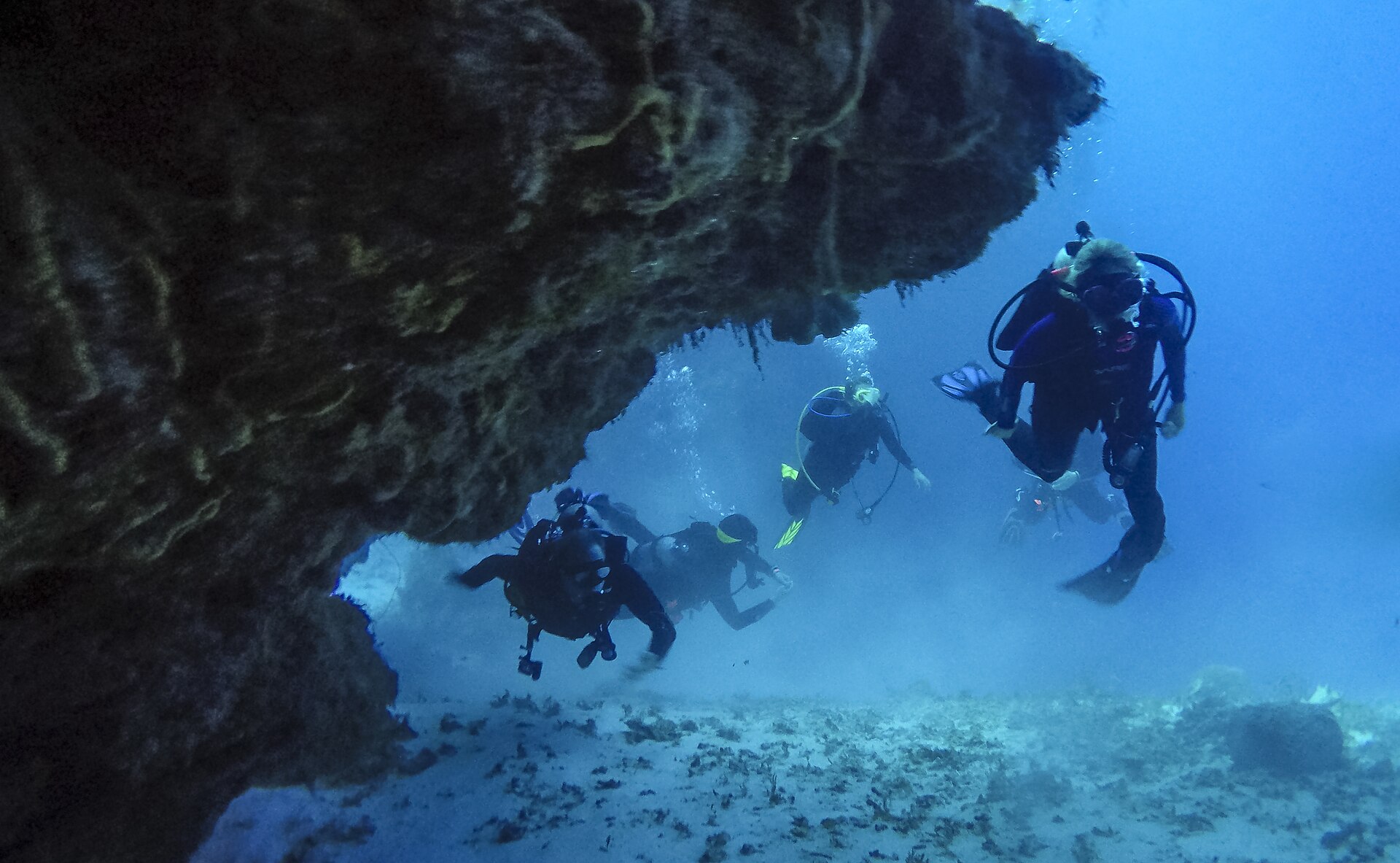
Santa Rosa is the wall everybody means when they say Cozumel. Pelagic Ventures has it dropping from 50 feet into open blue, with a northward current carrying you past overhang after overhang, eagle rays in the water column and nurse sharks parked in the crevices. The shop dives it to 80 or 90 feet and rates it Intermediate. 2
PADI's own entry for the site adds the detail that sells the dive: tunnels cut clean through the reef at 80 feet. It recommends Santa Rosa for intermediate divers, on the strength of unpredictable currents and overhead environments. Lobster, barracuda, black grouper, horse-eyed jacks, eagle rays and turtles are the regulars. 8
Punta Sur is the one with a door in it. Devil's Throat, on the island's southern point, is a narrow tunnel you enter at 80 feet and exit at 130. More tunnels bring you back up through the coral toward the safety stop. The Cathedral section holds a large cavern at about 110 feet. Both are rated Advanced, 60 to 130 feet. 1
What certification do you need for each site?
The floor two Cozumel operators publish, and the sites each level gets.
Open Water is the working floor, and it covers more of Cozumel than divers expect. Pelagic Ventures says an Open Water card is enough for most of the island's drift dives, and calls Cozumel one of the best places in the world for a first drift. Faster water and greater depth move a site up the scale from there. 2
| Dive site | Level | Depth (ft) | Current | What you go for |
|---|---|---|---|---|
| Paraiso Reef (Paradise Reef) | Beginner | 30-40 | Mild, south to north | The first site inside the park, outside Marina ASIPONA; checkout dives, macro and night diving |
| Columbia Shallow | Beginner | 20-30 | Mild | A second-tank photography dive with most of the island's tropical fish |
| Palancar Gardens | Beginner | 30-80 | Mild | Coral heads and sand, turtles and eagle rays |
| Tormentos | Intermediate | 50-60 | Mild to swift | Cleaning stations, nurse sharks, turtles and eels |
| Paso del Cedral | Intermediate | 40-60 | Moderate to swift | The island's densest second-tank drift; nurse sharks and splendid toadfish |
| Palancar Horseshoe | Intermediate | 30-90 | Mild to moderate | A steep coral amphitheater and barracuda |
| Santa Rosa Wall | Intermediate | 50-90 | Moderate to strong | Tunnels at 80 ft, overhangs, eagle rays and nurse sharks |
| Wreck C-53 | Intermediate | 50-80 | Mild to swift | A 184 ft Mexican Navy minesweeper on sand, with cut entries |
| Palancar Caves | Intermediate to Advanced | 40-130 | Mild to moderate | Pinnacles and a maze of swim-throughs |
| Palancar Bricks | Intermediate | 40-130 | Mild to moderate | Pinnacles, sandy slopes and reef sharks |
| Columbia Deep | Advanced | 60-130 | Mild to moderate | Towering pinnacles and sand chutes into open water |
| Cantarel (Eagle Ray Wall) | Advanced | 40-100 | High-speed northern drift | Winter spotted eagle ray migrations |
| Punta Sur (Devil's Throat, Cathedral) | Advanced | 60-130 | Mild to moderate | A tunnel from 80 ft to 130 ft, and a cavern at about 110 ft |
| Maracaibo | Advanced | 60-130 | Unpredictable | The wild southern point and large pelagics |
| Chun Chacaab | Advanced | 60-100 | Not stated by operator | Deep reef structure the operator calls untouched |
| Barracuda (North) | Advanced | 90-130 | Extreme | Hammerheads and eagle rays in serious current |
| Tiburones (North) | Advanced | 80+ | Not stated by operator | A special deep excursion, run with a minimum of 6 divers |
Level tags, depths and current ratings are the operators' own, with the advanced sites re-read on 28 September 2026. Read the current column as the operator's own wording, not as a difficulty ranking: Blue Note Scuba gives the same mild-to-moderate, south-to-north current to most of its sites, Columbia Deep and Punta Sur included, and lists no current at all for Chun Chacaab and Tiburones. The level tag is what moves at those sites. Santa Rosa Wall's band here follows Pelagic Ventures, which works the wall from about 50 to 90 ft; PADI's own entry gives only the 80-foot tunnels and no depth range. Blue Note Scuba's own page gives 40-130 ft in one place and 60-80 ft in another. Maracaibo, Chun Chacaab, Barracuda and Tiburones appear only in a summary table, with no fuller description behind them. 1, 2, 8
- Open Water, a handful of dives, no current behind you: ask for the shallow reefs. Columbia Shallow at 20 to 30 feet and Palancar Gardens at 30 to 80 feet carry the Beginner tag. 1
- Open Water, comfortable in a drift: Tormentos and Paso del Cedral. Pelagic Ventures runs both for Open Water divers who are happy in moderate to strong water. 2
- Advanced Open Water, with deep dives logged: Columbia Deep, Cantarel, Maracaibo and the north sites. 1
- Advanced plus a dive with the same shop: Punta Sur. That is Pelagic Ventures' own rule, and it is the tightest condition on the island's site list. 2
Advanced Open Water is five dives: two required ones, deep diving and underwater navigation, plus three you choose from what the local water offers. Cozumel is a sensible place to earn it, since the deep dive and the drift are both right there. MMT's scuba certification cost page prices the course. 12
How much does the marine park fee add?
One operator's own 2026 price list, site by site, in pesos and dollars.
The park charges per diver per day, and some sites charge more than others. Blue Note Scuba's 2026 price list puts the base marine park fee at USD 15, or 220 pesos, cash only, on top of the dive. Punta Sur, Maracaibo and Chun Chacaab add USD 25 a person. Columbia, Barracuda and the north sites add USD 20. 3
| Sites the boat runs | 2-tank dive (USD) | Park fee (USD) | Site surcharge (USD) | Day total (USD) |
|---|---|---|---|---|
| Palancar, Santa Rosa, Tormentos and the standard reefs | 130 | 15 | 0 | 145 |
| Columbia, Barracuda and the north sites | 130 | 15 | 20 | 165 |
| Punta Sur, Maracaibo and Chun Chacaab | 130 | 15 | 25 | 170 |
| Tiburones, far north, minimum 6 divers | 130 | 15 | 185 | 330 |
| Spread between the cheapest and the dearest day | 185 |
Figures are Blue Note Scuba's own 2026 price list, read on 25 September 2026. The same lines in pesos: 2,300 for the dive, 220 for the park fee, 350 and 400 for the two surcharges, 3,400 for Tiburones. The park fee is cash only. Blue Note Scuba's price list does not say whether gear and tax are included in the USD 130. Ask when you book. 3
Table view: What the site does to the day's bill
| Item | Value (USD) |
|---|---|
| Tiburones, far north | $330 |
| Punta Sur, Maracaibo, Chun Chacaab | $170 |
| Columbia, Barracuda, north sites | $165 |
| Standard reefs | $145 |
A standard reef day and a Punta Sur day sit USD 25 apart, which is the price of the tunnel. Tiburones is its own category at more than double a standard day, and it sails only with six divers aboard. Source: 3
Pay the park fee in pesos and it comes out cheaper. At the Federal Reserve's rate of 17.2454 pesos per dollar on 18 September 2026, the 220-peso fee works out at USD 12.76, some USD 2.24 under the USD 15 sticker. The dive itself runs the other way: 2,300 pesos converts to USD 133.37 against a USD 130 sticker. Carry both currencies. 3, 13
The fee has a history worth knowing. Punta Sur Divers recorded a federally mandated increase that took effect on 1 January 2025 and lifted the daily park fee to 218.32 pesos from 108, a little more than double, and the first rise since 2020. That is where today's 220-peso figure comes from. 6
One warning about published fees. Aldora Divers' own 2026 page still lists the marine park fee at USD 2 a day. Three current-dated operator pages differ by seven and a half times on the same government charge, from USD 15 down to USD 2. Ask your shop what it will collect, and hold cash pesos for it. 5, 3, 6
Which sites are the best second-tank drifts?
Paso del Cedral is the one guides talk about. Pelagic Ventures describes a reef so dense with life that the problem is choosing what to stop for: nurse sharks in the sandy patches, cleaning stations busy with fish waiting their turn, and a splendid toadfish sitting in its crevice while the current runs over it. The operator calls it one of the best second-tank drifts on the island. 2
Tormentos is the photographer's version. Blue Note Scuba rates it Intermediate at 50 to 60 feet with a mild-to-swift current. Pelagic Ventures says the pace swings day to day, and that on the calm days you can hold at a cleaning station and wait for the toadfish to come out. 1, 2
The toadfish is the island's signature fish, and its range is under argument. Blue Note Scuba states the splendid toadfish is found nowhere else, reaches 12 inches, and lives between 20 and 130 feet in coral crevices, most active at night. Other reports place it off Honduras and near Cancun. 15
For a change of texture, the C-53 sits on sand at 80 feet. She is a 184-foot Mexican Navy minesweeper sunk in June 2000, with large holes cut in her sides so divers can pass through safely. Glassy sweepers and sardines inside, barracuda and grouper outside, and the Atlantis submarine cruising past on occasion. 1
When should you go for the eagle rays?
Spotted eagle rays arrive in winter, and Cantarel is where they stack up. Blue Note Scuba puts the season from December through March and names Cantarel, also called Eagle Ray Alley, as the best odds on the island, sometimes more than 20 rays in a single dive. Palancar and Villa Blanca get regular sightings too. 4
Cantarel costs something in skill. The operator rates it Advanced, 40 to 100 feet, and calls it a high-speed northern drift. Winter also brings the coolest water of the year, so the ray season and the thickest wetsuit turn up together. 1, 16
| Months | Water (F) | Water (C) | What to wear |
|---|---|---|---|
| December to February | 78-80 | 26-27 | A 3mm full suit, or a 5mm shorty |
| June to October | 83-86 | 28-30 | A rash guard or a swimsuit |
Figures are Blue Note Scuba's own monthly table. Its live reading on 25 September 2026 was 30C, or 86F, the warmest part of the year. January and February are the coldest months, averaging about 78F. The summer band here runs warmer than the 75 to 84F year-round range the other operator publishes; each shop is describing its own water.
The seasonal trade is a real one. Come in January or February for rays in 78-degree water, and pack the thicker suit. Come in September and you dive in 86 degrees with a rash guard, and the rays are elsewhere. If it were our week to book, we would take January and rent the thicker suit. The reef keeps. The rays only pass through. 16, 4
Whose water this is
Every site on this page sits in a Mexican national park, and Mexico sets the price of entering it. Arrecifes de Cozumel was decreed on 19 July 1996 and covers 11,987.88 hectares in the municipality of Cozumel, Quintana Roo, of which 11,905.60 hectares are sea. CONANP, the federal protected areas commission, administers it. 7
That is why the fee moves by decree and not by shop. The 2025 increase to 218.32 pesos a day was a federal decision applied across national parks, as one Cozumel operator recorded at the time. Your shop collects the money. The park sets the number. 6
Cozumel is a Maya island, and San Gervasio is the island's own record of that. The zone east of San Miguel de Cozumel is cared for today by Centro INAH Quintana Roo. INAH dates most of the buildings standing there to the late Postclassic, between 1200 and 1450, when San Gervasio was the island's main city and smaller communities all across Cozumel depended on it. INAH lists the zone as temporarily closed. 17
INAH's own page tells two stories about Ixchel, the goddess of midwifery, fertility, medicine and weaving. Its summary calls San Gervasio a site dedicated to her, and says women from the mainland settlements made the pilgrimage to her sanctuary. Its cultural-relevance section says the Spanish chroniclers were describing a different sanctuary, now destroyed, under the streets of San Miguel de Cozumel, and that nothing found at San Gervasio ties it to that cult. 17
People speak Maya on Cozumel today. INALI, Mexico's national institute for Indigenous languages, lists Maayat'aan among the languages spoken in eleven Quintana Roo municipalities, Cozumel among them, and counts 774,755 speakers of it across Mexico on the 2020 census. 18
The rest of the trip lives on the mainland. MMT's Mexico travel guide covers arrival, money and moving around the peninsula, and the Playa del Carmen bull shark dive page covers the other big winter dive in this water.
Frequently asked questions
Do I need Advanced Open Water to dive Cozumel?
For most of the island, no. Pelagic Ventures says an Open Water card covers most Cozumel drift dives, including Columbia Shallow and Tormentos. Advanced Open Water plus a prior dive with the same shop is what it asks for at Punta Sur. The same page's FAQ also names Santa Rosa Wall as needing Advanced, while its own site notes rate that wall Intermediate. Ask your shop which rule it applies. 2
Which Cozumel dive site is best for a first boat dive?
Columbia Shallow at 20 to 30 feet, or Palancar Gardens at 30 to 80 feet. Both carry the Beginner tag with a mild current. There is a third: Paraiso Reef, the shallow reef just outside Marina ASIPONA at 30 to 40 feet, which shops use for checkout dives, macro photography and night diving. Any shop on the island will know it, under that name or its English translation. 1, 11
How deep is Palancar reef?
It depends which Palancar. Gardens runs 30 to 80 feet, Horseshoe 30 to 90, and both Caves and Bricks 40 to 130 on the operator's per-site entries. A summary table on the same page gives narrower bands for each, so plan a range instead of a number and confirm the profile at the briefing. 1
What is the Columbia wall dive like?
Columbia Deep is rated Advanced at 60 to 130 feet, and the Advanced tag is about the depth, not the water: the operator's own current field for the site reads mild to moderate. Columbia Shallow, at 20 to 30 feet, is the calm second tank under the same name. Either version carries a USD 20 surcharge a person on top of the park fee at that operator, so a Columbia day costs USD 165. 1, 3
How much is the Cozumel marine park fee in 2026?
USD 15, or 220 pesos, per diver per day at Blue Note Scuba, cash only, with USD 20 to 25 more at the named advanced sites. Punta Sur Divers records the federal figure as 218.32 pesos a day since 1 January 2025. Aldora Divers' own 2026 page still shows USD 2. Confirm the number with your shop before you book. 3, 6, 5
When can I dive with eagle rays in Cozumel?
December through March, and Cantarel gives the best odds. It is a fast drift rated Advanced, so bank a few current dives before you ask for it. Ray season is also the coldest water of the year: January and February average about 78F, which is a 3mm full suit or a 5mm shorty instead of the rash guard September divers wear. Book the rays and pack the thicker suit together. 4, 1, 16
How strong is the current when drift diving in Cozumel?
Around 1 to 2 knots at most standard sites, which one operator calls a comfortable drift pace, and considerably faster on strong-current days at exposed sites. Guides assess the current before entry and can switch the site. Barracuda in the north carries the reputation for extreme current. 2, 1
Do I need a wetsuit in Cozumel?
In winter, yes. Water sits at 78 to 80F from December through February, and the operator suggests a 3mm full suit or a 5mm shorty. From June to October the water runs 83 to 86F and a rash guard covers it. The live reading on 25 September 2026 was 86F. 16
Sources & review date
Researched 2026-09-28. Prepared from primary sources, with a separate independent source review. Numbered notes in the text point to the sources below. Prices, entry rules and schedules change; use the linked authority for your dates.
- 1Cozumel dive sites: the operator's own reef guide, with level, depth and current per site Blue Note Scuba · Accessed 2026-09-28 · Primary source
- 2Drift diving Cozumel: sites, skill levels, current and certification Pelagic Ventures · Accessed 2026-09-25 · Primary source
- 3Scuba diving Cozumel price list 2026, with marine park fees and per-site surcharges Blue Note Scuba · Accessed 2026-09-25 · Primary source
- 4Scuba diving with eagle rays in Cozumel, Mexico Blue Note Scuba · Accessed 2026-09-25 · Primary source
- 5Prices and schedules, 2026 Aldora Divers · Accessed 2026-09-25 · Primary source
- 6Price hike to the park fees, effective 1 January 2025 Cozumel Dive Center / Punta Sur Divers · Accessed 2026-09-25 · Primary source
- 7Ficha SIMEC: Parque Nacional Arrecifes de Cozumel, decree date, area and administration CONANP, Comision Nacional de Areas Naturales Protegidas · Accessed 2026-09-28 · Primary source
- 8Santa Rosa Wall dive site, Mexico PADI dive-site database · Accessed 2026-09-25 · Primary source
- 9Contact DAN: diving emergency hotlines by region Divers Alert Network · Accessed 2026-09-25 · Primary source
- 10SSS recompression chamber, Playa del Carmen: 24-hour diving emergency line SSS Recompression Chamber Network · Accessed 2026-09-25 · Primary source
- 11Paraiso Reef, Cozumel: the first reef inside the marine park, off the local marina SSI MyDiveGuide dive-site database · Accessed 2026-09-28 · Primary source
- 12Advanced Open Water Diver course: two required dives and three electives PADI · Accessed 2026-09-25 · Primary source
- 13H.10 foreign exchange rates, Mexican peso, 18 September 2026 Federal Reserve Board · Accessed 2026-09-25 · Primary source
- 142-tank boat diving in Cozumel: what it costs and what is included Pelagic Ventures · Accessed 2026-09-25 · Primary source
- 15Marine life unique to Cozumel: the splendid toadfish Blue Note Scuba · Accessed 2026-09-25 · Primary source
- 16Cozumel water temperature, month by month Blue Note Scuba · Accessed 2026-09-25 · Primary source
- 17Zona Arqueologica San Gervasio, Cozumel Instituto Nacional de Antropologia e Historia (INAH) · Accessed 2026-09-28 · Primary source
- 18Maayat'aan (maya): territory, speaking population and the municipalities where the language is spoken Instituto Nacional de Lenguas Indigenas (INALI) · Accessed 2026-09-28 · Primary source