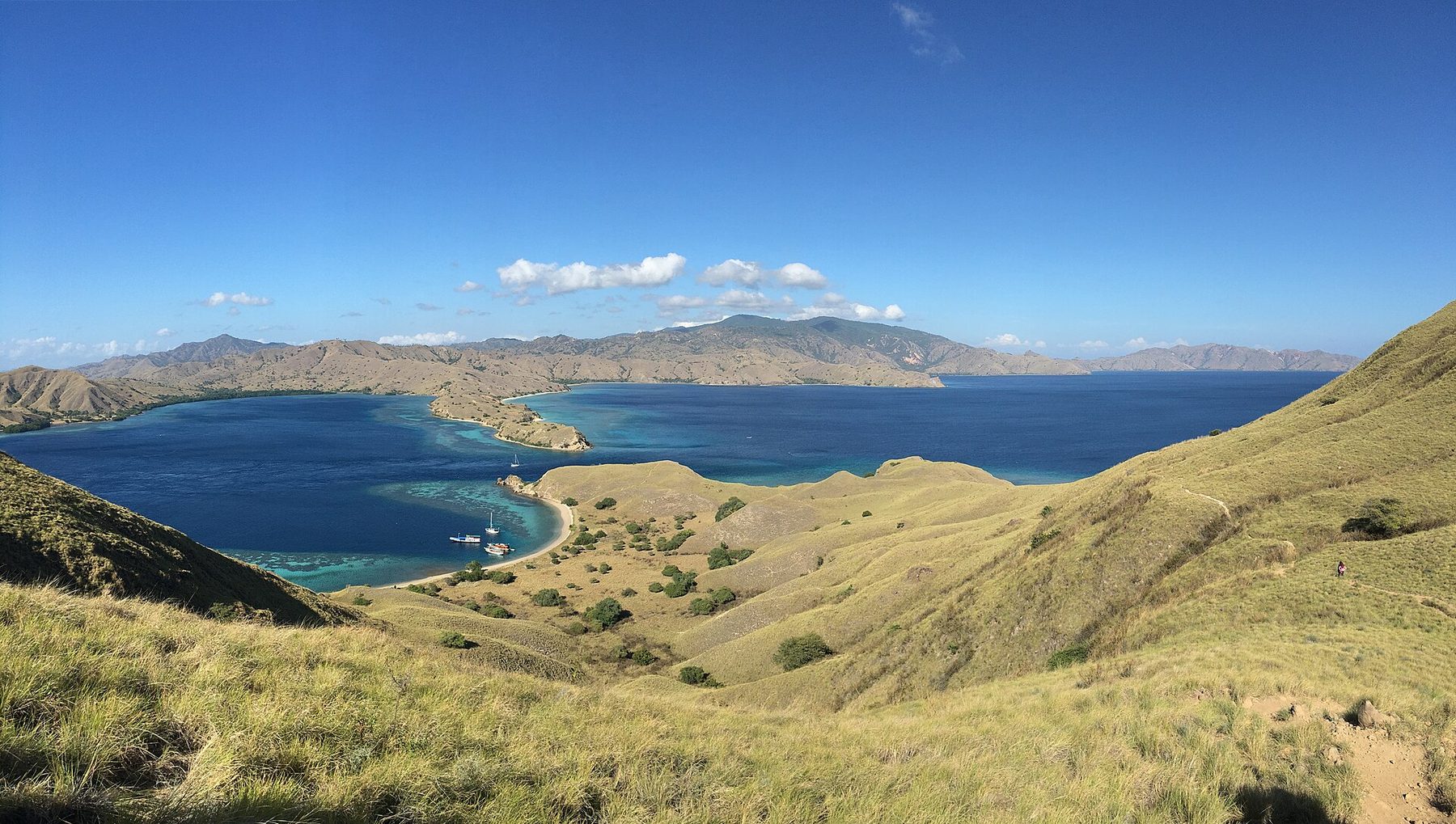
Two seas in one park, and the month they overlap
At Batu Bolong the current arrives before you do. You drop into 28°C water on the sheltered side of a pinnacle, tuck in behind the rock, and watch fusiliers stack up like traffic. 2, 3 4 to 5 hours south by boat, the same park runs 20 to 25°C, and the thermoclines there come as standard. 2
One park, two seas. North and central Komodo dive well from roughly April to November and peak in July and August. The south faces the open Indian Ocean and the full fetch of the southeast monsoon, which closes it through July and August and reopens it around October. 2, 1 September and October are the seam between the two.
Every figure comes from a dive operator's own conditions page, Indonesia's meteorological agency, or a peer-reviewed count of 1,085 photo-identified manta rays in the park. 8 If the bill is your question instead, what a Komodo trip costs in 2026 has the park fees and the boat fares.
Is September a good month to dive Komodo?
Four sources publish September and October figures, one of them twice. They agree on the shape of the month and differ by about 3°C on the reading.
Yes, and two of the three operators that write it up rank it above August for crowds and price. Komodo Resort's own month table reads 25°C and 15 to 25m of visibility for September, with reliable big-fish sites. Scuba Republic's September write-up reads 27 to 28°C and 25 to 30m. Dragon Dive Komodo calls it the sweet spot and its top choice for 2026, at about 25 to 27°C. 3, 4, 5
| Source | Water (°C) | Visibility (m) |
|---|---|---|
| Komodo Resort, month table | 25 | 15 to 25 |
| Dragon Dive Komodo | 25 to 27 | not published |
| Scuba Republic | 27 to 28 | 25 to 30 |
Blank cells are cells the source leaves blank on the research date. Komodo Resort's month table carries no update date of its own, only a 2015 to 2026 copyright range.
| Source | Water (°C) | Visibility (m) |
|---|---|---|
| Komodo Resort, month table | 26 | 20 to 25 |
| Komodo Resort, October article (north) | 28 to 29 | 18 to 28 |
| Dragon Dive Komodo | 26 to 28 | not published |
Blank cells are cells the source leaves blank on the research date. The satellite reading for September and October appears in the paragraph below, not in this table, since it is a broad area-wide average rather than a per-operator figure.
The satellite series moves the other way from the operators' thermometers. It puts September at 27.3°C and October at 28.6°C, a rise of 1.3°C, against a yearly low of 26.7°C in July and August and a high of 30.0°C in December, a swing of 3.3°C across the year. 9 That is a surface average for the whole area. The suit you rent depends on the zone.
September also costs less. Scuba Republic notes that many hotels drop their rates after August and that flights and liveaboard berths open up. 4 If you are weighing a boat against a bed on shore, the liveaboard and shore-diving cost comparison sets the two side by side.
What is Komodo's water temperature?
Two answers, and the honest one names the zone first. The park runs two thermometers about 9°C apart.
North and central Komodo sit at 27 to 29°C nearly year round, warmest in July and August. South Komodo drops to 20 to 25°C, and colder at depth, where cold upwelling meets the Indonesian Throughflow squeezing 15 to 20 Sverdrups of Pacific water through the Sape and Linta straits. 1 One park, two suits.
| Zone | Water in October (°C) | Visibility in October (m) | Suit | Season |
|---|---|---|---|---|
| North and central: Batu Bolong, Castle Rock, Karang Makassar | 28 to 29 | 18 to 28 | 3mm or a shorty | About April to November, peak July and August |
| South: Manta Alley, Cannibal Rock, Horseshoe Bay, Yellow Wall | 20 to 25 | 10 to 20 | 5mm with a hood | Opens about October, holds to March or April |
Zone boundaries follow the operators' own usage: north and central covers the sites reachable on a day trip from Labuan Bajo, south covers the liveaboard-only sites past Padar. Scuba Junkie Komodo dates the north's window slightly wider, March or April to October or November, and the south's October to March.
The spread is the planning fact. Take 29°C at the top of the north's range against 20°C at the bottom of the south's and you get a 9°C difference inside one national park. 1 Then add the thermocline. Komodo Resort's October article puts it at 3 to 4°C between roughly 15 and 22 metres in the south, so 20°C at the surface reads 16°C on your computer at depth. 2
Which months have the best visibility?
April, May, June and October are the blue-water months on the northern pinnacles, the four with a 20m floor, by the reckoning of the one operator that publishes month-by-month figures. May tops it at 20 to 30m. October reads 20 to 25m. September shares October's ceiling and sits 5m lower at the floor. 3
Table view: Visibility by month, one dive center's published range
| Item | Low reading (m) | High reading (m) |
|---|---|---|
| April | 20 m | 25 m |
| May | 20 m | 30 m |
| June | 20 m | 25 m |
| July | 15 m | 25 m |
| August | 15 m | 25 m |
| September | 15 m | 25 m |
| October | 20 m | 25 m |
| November | 15 m | 20 m |
| December to February | 10 m | 20 m |
Watch the floor, not the ceiling. October lifts the low reading back to 20m, double the 10m floor of the December to February manta season, and the high reading holds at 25m. These are one operator's figures for its own sites; a boat working the south in the same month reports 10 to 20m. The source groups December to February and does not publish a separate March figure. Source: 3
September's own range spans 10m, from 15m to 25m, which is the width of a month that can hand you a blue day or a green one. 3 The wider pattern across operators is steadier: 15 to 30m is what Komodo gives most of the year, because the current that stirs the reef also clears it. 7
Why the current is the reason the reefs are crowded
The same flow that makes Castle Rock a drift dive is what feeds everything on it.
Komodo sits in the path of the Indonesian Throughflow, the river of Pacific water forced toward the Indian Ocean, and it speeds up through the narrow channels between Komodo, Rinca and Gili Lawa. Twice-daily tides amplify it. In the June to August southeast monsoon, surface current in the straits reaches 7 to 8 knots. 1, 7
That movement pulls cold, nutrient-rich water onto the reef. Corals grow fat, anthias swarm, and the big animals gather where the food is. It also keeps visibility at 15 to 30m for most of the year. 7 So you drift with it and hook into bare rock when you want to stop. The current is the product, and the diving is built around reading the tide.
| Site | Current | Window to aim for | Who it suits |
|---|---|---|---|
| Batu Bolong | Variable, often strong | Slack water or a gentle exchange | Experienced divers with current skills |
| Castle Rock and Crystal Rock | Strong, channel-fed | A tight tidal window | Experienced divers; the shark dives |
| Karang Makassar (Manta Point), 5 to 18m | Mild to moderate | Slack or a rising tide | Open Water divers |
| Mawan, 8 to 20m | Gentler than Manta Point (not separately rated) | No published tidal guidance | Open Water divers |
| Siaba Besar | Mild, sheltered | Most of the tide | New divers; reliable turtles |
Depths for the two central cleaning stations come from Manta Dive Komodo, which also rates them Open Water accessible. Manta Alley in the south is 10 to 25m and rated Advanced. Site windows shift with the moon; the boat's briefing governs.
The same operator publishes goal-based shortcuts that line up with the table. June through September is its pick for sharks, because the strong exchange pulls nutrients past Castle Rock, Crystal Rock and Shotgun. November through February is its pick for mantas. 3 September and October straddle the handover.
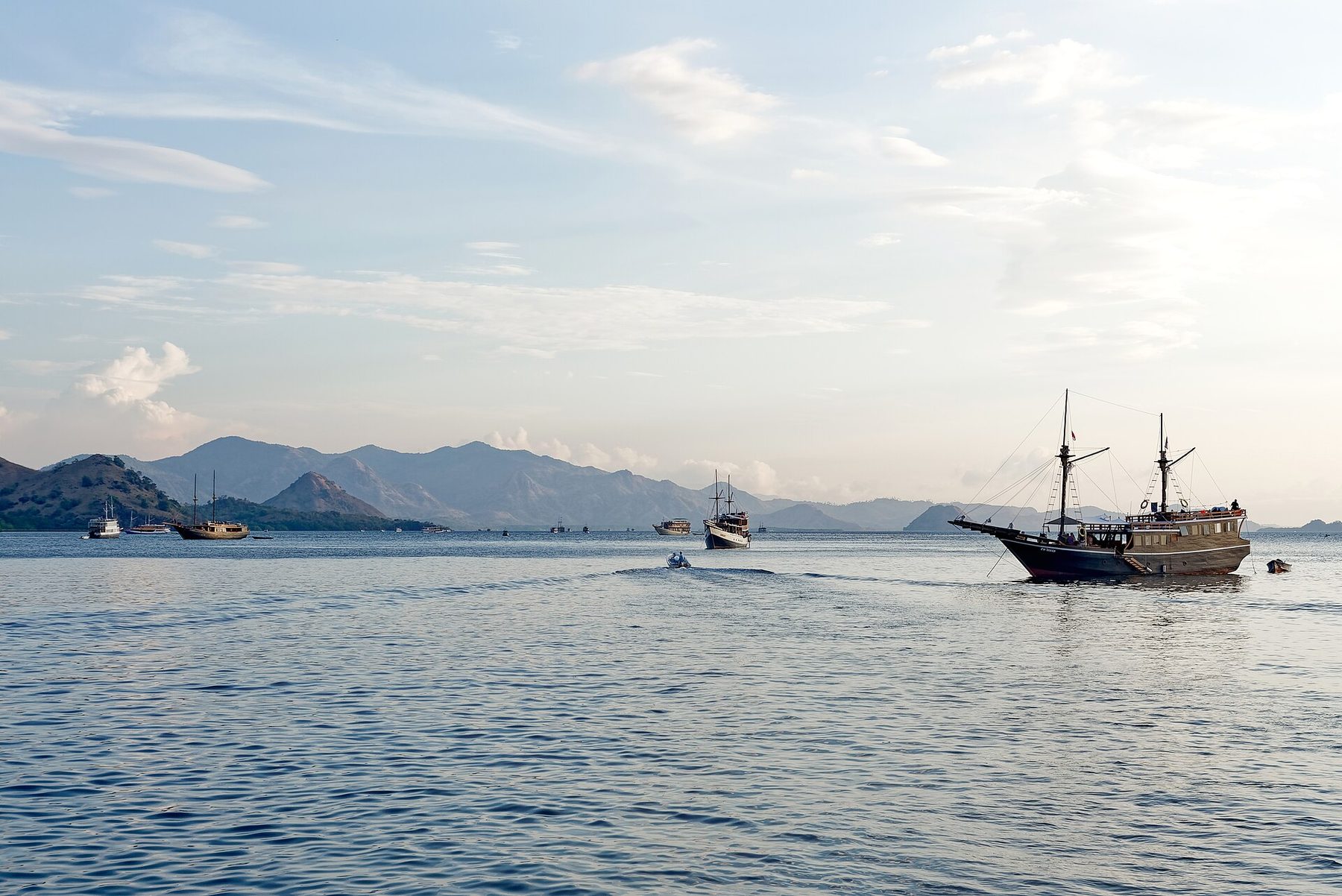
Where are the mantas in September and October?
At the central cleaning stations, all year, in numbers that build through October. Karang Makassar and Mawan hold reef mantas even in the thin July and August window. The trains of twenty, thirty animals and more are most reliably seen from roughly September through May, and December to February is the standout stretch. October sits on the rising edge of that curve. 2
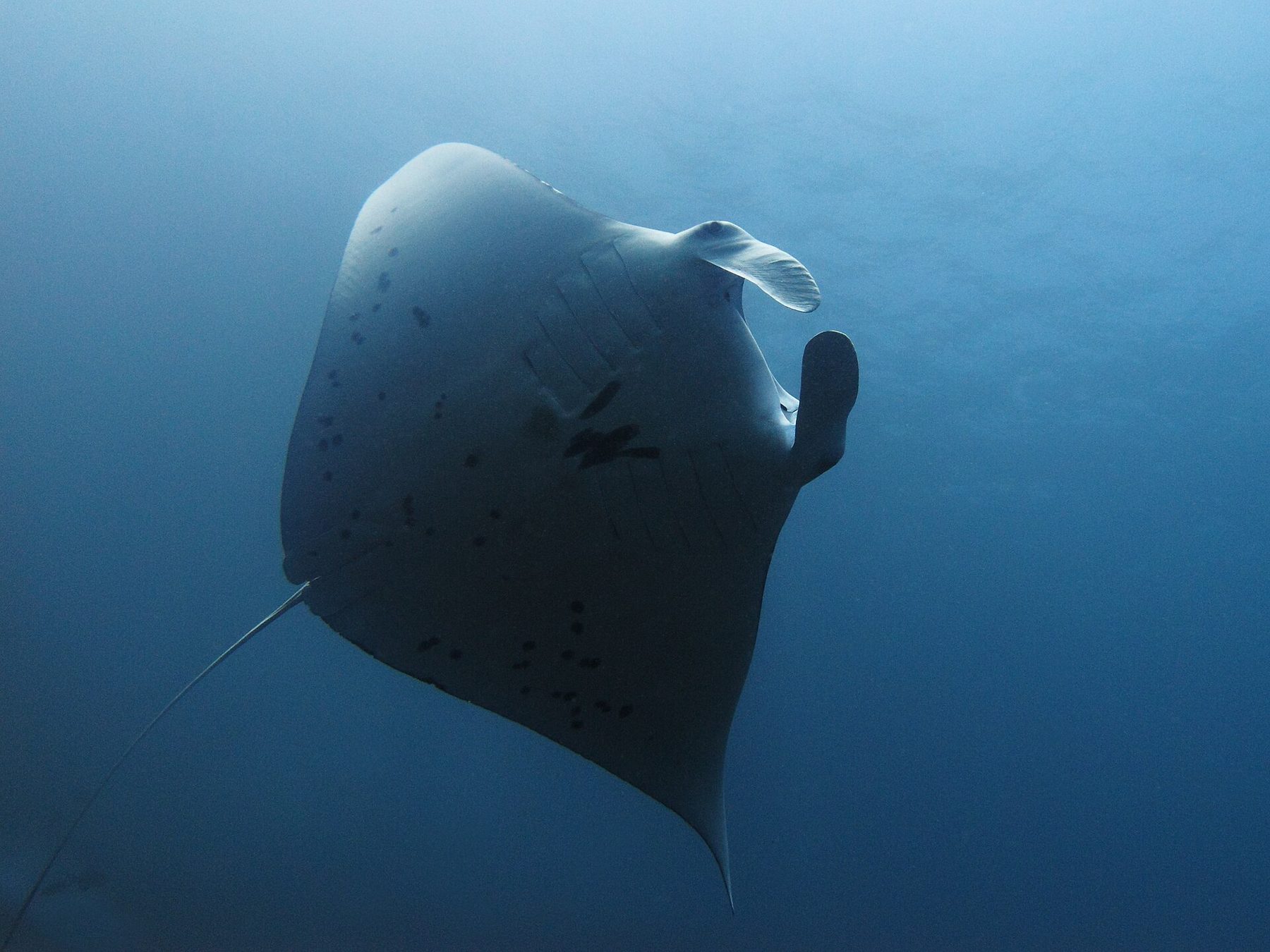
- Karang Makassar, better known as Manta Point, 5 to 18m and open to Open Water divers. Reef mantas year round, with the 20 to 30 animal aggregations concentrated from September through May. 2, 6
- Mawan, 8 to 20m, the second central cleaning station, on the same calendar and the same certification level. 6
- Manta Alley in the south, 10 to 25m and rated Advanced, for reef mantas and the rarer oceanic manta at up to 7m across against 3 to 5m for a reef manta. Safely reachable from about October to April. 6, 2
One operator puts a sharper number on the dry-season dip. From May to October reef mantas enter their reproduction period and spread out, and central-site counts fall to about 1 to 5 animals a dive, against 10 to 20 at a single station in January and February. 6 October is the turn in that curve: counts build from there through December.
The academic record backs the direction of travel. A study of 1,085 individually identified reef mantas in the park, covering 2013 to 2018, recorded more animals moving from the southern site to the central sites than the other way, and logged its highest single-day count of foraging mantas at Karang Makassar during the northwest monsoon of November to April. 8
When does Komodo's rainy season start?
The park sits in one of Indonesia's driest corners. October is the hinge, and 2026 arrived at its dry season on schedule.
Komodo's dry season runs May to October, on 800 to 1,000mm of rain a year and daytime air around 40°C. 11 Indonesia's meteorological agency dated the 2026 dry season to April, May and June, beginning in Nusa Tenggara, the region Flores and Komodo sit in, after a weak La Niña ended in February. 12
The ground held to that on the research date. BMKG's live page for Labuan Bajo read 26°C air, clear skies, 83% humidity and a light 3 km/h easterly at 18:00 WITA on 26 September 2026, with clear to partly cloudy conditions and 23 to 30°C forecast through 5 October. 13
October is where the calendar turns, and the published rainfall figures for Labuan Bajo argue with each other about how hard. One long-term dataset puts the month at 89mm across about four rainy days. A second gives 99mm, then contradicts itself further down the same page with 146mm across twelve days, a spread of 57mm between the low and high figures. 2
The practical read, from the operator that raised the rainfall problem in the first place: the first half of October generally behaves like September, dry and bright and steady, and the second half starts hinting at what is coming. 2 Book the first fortnight if the weather matters more than the mantas.
How do you plan a trip that reaches both halves?
Five decisions, in the order they bind. The window comes before the boat, and the boat comes before everything else.
Only a liveaboard of five to six nights or more reaches both zones on one trip, and only in the transitional windows of roughly March to April and September to October. In peak dry season the south is typically rough, and no day trip out of Labuan Bajo gets there at all. The one-week Komodo itinerary walks through what that boat and that route look like. 1, 2
Book three to six months out
The park's 1,000-visitor-a-day quota in 2026 has tightened the booking window for July through October, by one operator's account. 5
Ask which zones the itinerary actually covers
Operators drop Manta Alley from the route when the swell is up. Some years it settles in the first week of October, some years not until November, so ask which zones the itinerary actually covers. 2
Certification sets the rest. The central cleaning stations and Siaba Besar are Open Water work; Castle Rock, Crystal Rock and Manta Alley want an Advanced card and current experience. 6, 3 Komodo sits inside a wider Indonesian trip for most people, and the Indonesia country guide covers the islands and the arrival.
Frequently asked questions
What is the best month to dive Komodo?
North and central Komodo peaks in July and August, the south opens October to April, and September to October or March to April is the seam that works for both, on a liveaboard of five to six nights or more. The plan section above breaks down the boat and the booking window. 3, 1, 2
Is Komodo diving good in September?
Two of three rate it excellent outright: Dragon Dive Komodo says 'Excellent,' Scuba Republic calls its visibility excellent. Komodo Resort's own table is more measured, filing September as 'reliable big-fish sites, still busy but worth it.' The September section above has the numbers. 3, 4, 5
How cold is the water in south Komodo?
20 to 25°C at the surface and colder at depth once the thermocline hits, against 28 to 29°C in the north the same month. The temperature section above has the zone-by-zone breakdown and the suit to bring. 2, 1
Can I dive Manta Alley in September?
Rarely. The site is exposed to the full fetch of the southeast monsoon and most operators drop it from the itinerary through July and August. In July, Manta Alley can mean short, choppy seas and 5 to 10m of visibility. The window opens around October. 2, 1
Do I need an Advanced certification to dive Komodo?
No for the central stations and Siaba Besar, all rated Open Water accessible; yes for Manta Alley, Castle Rock and Crystal Rock, where the current wants an Advanced card and experience. The plan section above has the certification breakdown by site. 6, 3
Is October part of Komodo's rainy season?
October is the hinge, not fully wet or dry: the first half generally behaves like September, and the second half starts turning. The rain section above has the rainfall figures and why they disagree. 11, 2
Sources & review date
Researched 2026-09-26. Researched on 26 September 2026 from seven named Labuan Bajo dive operators' own conditions and season pages, Indonesia's national meteorological agency (BMKG) for live and seasonal data, a peer-reviewed study of 1,085 photo-identified manta rays in the park, and a satellite sea-surface-temperature aggregator that credits NOAA. Operator pages disagree with each other on which monsoon drives the cold water in the south and on the dry-season temperature bands; those conflicts are recorded in the box below instead of being smoothed over. Conditions change; open the linked page for your own dates.
- 1North vs south Komodo diving Labuan Bajo Diving · Accessed 2026-09-26 · Primary source
- 2Komodo in October Komodo Resort · Accessed 2026-09-26 · Primary source
- 3Komodo diving conditions: month-by-month water, visibility and current Komodo Resort · Accessed 2026-09-26 · Primary source
- 4Why September is underrated for diving in Komodo Scuba Republic · Accessed 2026-09-26 · Primary source
- 5Best time to dive Komodo: month-by-month calendar Dragon Dive Komodo · Accessed 2026-09-26 · Primary source
- 6Manta rays in Komodo Manta Dive Komodo · Accessed 2026-09-26 · Primary source
- 7Komodo diving currents Dive Tribe Komodo · Accessed 2026-09-26 · Primary source
- 8Residency, movement patterns, behavior and demographics of reef manta rays in Komodo National Park PeerJ (Germanov et al., 2022) · Accessed 2026-09-26 · Primary source
- 9Komodo sea temperature, monthly averages from NOAA satellite readings SeaTemperature.org · Accessed 2026-09-26
- 10Best time to visit Komodo Scuba Junkie Komodo · Accessed 2026-09-26 · Primary source
- 11Komodo National Park: climate Wikipedia, citing UNESCO and IUCN park datasheets · Accessed 2026-09-26
- 12Prediksi musim: dry season 2026 outlook and El Nino update Badan Meteorologi, Klimatologi, dan Geofisika (BMKG) · Accessed 2026-09-26 · Primary source
- 13Prakiraan cuaca Labuan Bajo Badan Meteorologi, Klimatologi, dan Geofisika (BMKG) · Accessed 2026-09-26 · Primary source
Also consulted
- Komodo season Komodo Resort · Accessed 2026-09-26 · Primary source