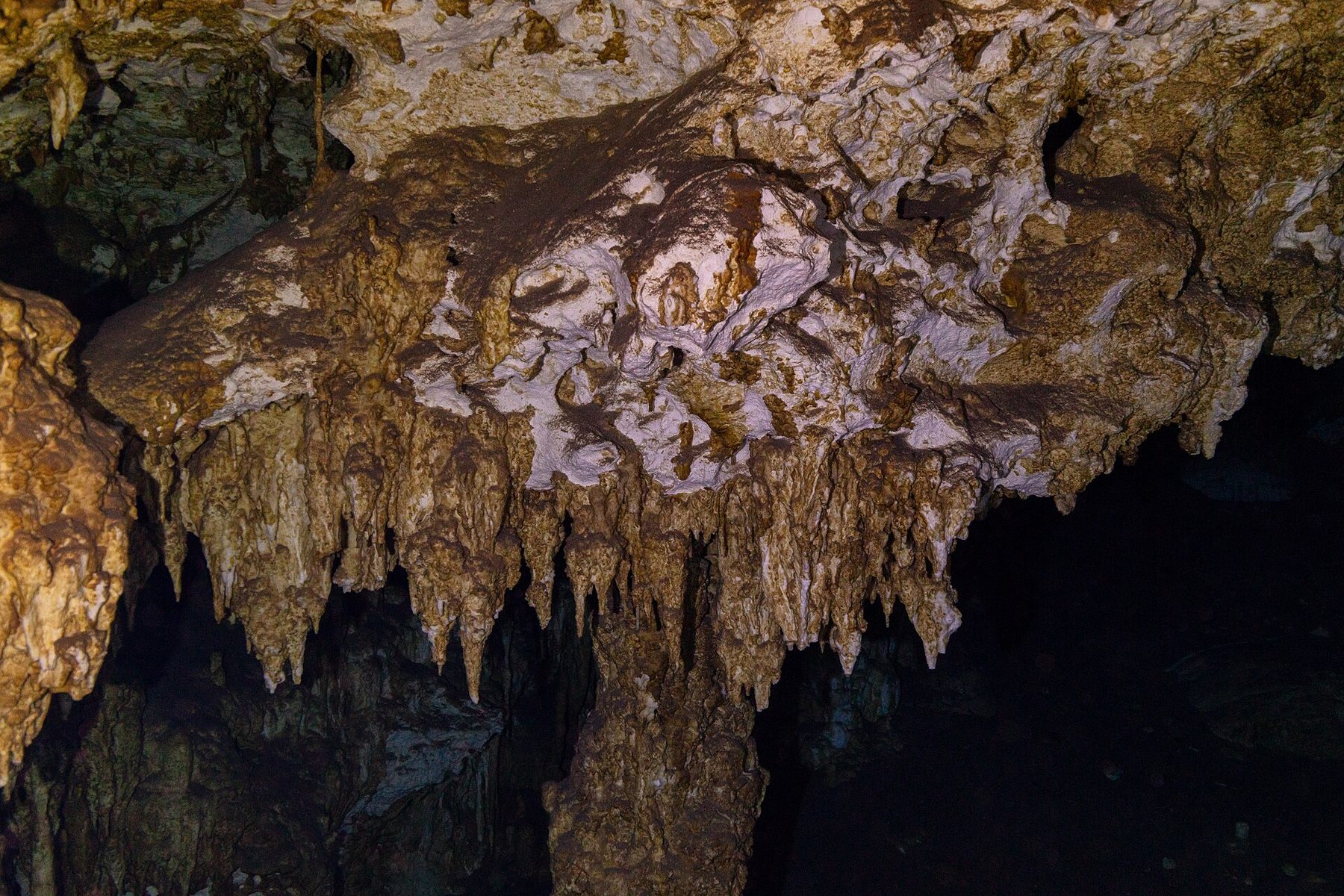
Cavern or cave: the line that decides your trip
Daylight drops through a hole in the jungle floor and turns the water into glass. Ten metres down, a guideline runs away between limestone columns into the dark. Visibility here sits at 50 to 100 m and beyond. 2 The water is 24 to 25C, about 75 to 77F, warm enough for a 3 mm suit and cool enough to feel like a different country from the Caribbean twenty minutes away. 1
Two words set the whole day: cavern and cave. Under The Jungle, a diving centre at Cenote Tajma-Ha, publishes the sharpest definition of the first one. Daylight stays visible through every part of the dive. Divers stay inside 200 feet of a surface with breathable air. The passages are wide enough for two divers side by side, and a continuous guideline is always within reach. 3
Cave begins where the daylight ends. Ko'ox Diving splits its own menu three ways, and the third heading reads "Cave Dives for Cave Certified Only". 4 Seth Dive Mexico puts the same rule in plain words: its guided trips hold inside the cavern zone, with natural light in sight and an exit a short swim away. Cave diving stays a separate discipline with its own training. 2
ProTec Dive Centers, with shops in Playa del Carmen and Tulum, builds its whole course ladder around that one boundary, and calls Mexico's cenotes the world's first-choice cave training destination. 9 The shop describes these caves as fragile, shallow and low on current, floored with fine sediment that one careless fin turns into a whiteout, so precision buoyancy is the skill every course drills. 9
| Question | Cavern zone | Cave |
|---|---|---|
| Daylight | Visible through the whole dive | Beyond the daylight limit |
| Distance from breathable air | Inside 200 feet | Further, on a continuous line |
| Who may dive it | Open Water divers with a qualified guide | Cave-certified divers |
| What the guide holds | Instructor plus cave diver, minimum | Cave diver |
| The course that covers it | Cavern Diver | Intro to Cave, then Cave Diver |
Depth limits and logged-dive minimums are the operator's own and differ shop to shop; the 200-foot penetration limit is Under The Jungle's published figure for its cavern tours.
Do you need certification for cenote diving?
Yes for the water, and the bar is lower than most planning threads suggest. The bar for the Cavern Diver card itself is higher.
Open Water, or the equivalent from another agency, is the entry ticket. Seth Dive Mexico's FAQ states it directly, and gives the reason: a cavern is an overhead environment, so a diver needs the skills a first certification teaches. 2 Visitors who arrive uncertified have two doors, a Discover Scuba session or the full Open Water course, both sold locally. 2
Under The Jungle publishes the fullest set of conditions for a guided cavern tour: Open Water certification, age 15 and over, 20 logged dives, a dive inside the past six months, and a clean fitness statement or a doctor's clearance. 3 The recency rule catches people out. Book the refresher for the day you land and the cenote day for the day after.
Earning the Cavern Diver certification is a separate and stricter thing. PADI's own course page asks for Advanced Open Water and age 18 before you enrol. 10 Tulum Diving Center goes one step further and wants Advanced Open Water plus a Sidemount certification, under either the TDI or the PADI version of the course. 7 Full cave sits at the top: ProTec's Cave Diver course opens only to divers already holding Cavern Diver and Intro to Cave Diver. 9
| Operator and product | What you need to hold | What you get |
|---|---|---|
| Seth Dive Mexico, guided cenote dive | Open Water or equivalent | A guided dive in the cavern zone |
| Under The Jungle, guided cavern tour | Open Water, 15+, 20 logged dives, dive inside 6 months | A private guided day, two dives |
| Ko'ox Diving, cave dive from Tulum | Your own cave certification | A dive past the daylight zone |
| PADI Cavern Diver course | Advanced Open Water, 18+ | The Cavern Diver certification |
| Tulum Diving Center, Cavern Specialty | Advanced Open Water plus Sidemount | The Cavern Diver certification |
| ProTec Dive Centers, Cave Diver course | Cavern Diver plus Intro to Cave Diver | The Cave Diver certification |
Agencies differ on minimum age: TDI's cavern route at Tulum Diving Center starts at 15 with parental consent, the PADI route at 18.
Advanced Open Water is the upgrade that unlocks the deep sites, and it is five dives: a deep dive and a navigation dive, then three electives. 11 Zen Diving in Tulum sells it for 10,000 pesos across about three days, Ko'ox for $584 from Tulum. 5, 4 Pricing that card at home instead? The scuba certification cost worksheet separates the tuition from the pool and open-water fees.
What does a day of cenote diving cost?
Four named operators publish prices. One day of guided diving lands between 3,000 pesos and $290, and the gap is mostly dive count and pickup point.
A single guided cavern dive starts at 3,000 pesos, about $174, and a three-dive day tops out near 5,000 pesos. Zen Diving, in Tulum for more than ten years, puts instructor, equipment, cenote entrance fees, transport, snacks and water inside that figure. 5 Ko'ox Diving prices by package instead: two cenote dives from Tulum at $249, one cave dive at $249, two cave dives at $289, leaving at 8 a.m. 4
| Operator and product | Price, MXN | Price, USD | What the price covers |
|---|---|---|---|
| Zen Diving, cavern tour, 1 dive | 3,000 | 174 | Instructor, gear, entrance fees, transport, snacks |
| Zen Diving, cavern tour, 2 dives | 3,600 | 209 | Same, two dives |
| Zen Diving, cavern tour, 3 dives | 5,000 | 290 | Same, three dives |
| Zen Diving, cave tour, 1 dive | 4,000 | 232 | Cave-certified divers only |
| Zen Diving, cave tour, 2 dives | 5,000 | 290 | Cave-certified divers only |
| Ko'ox Diving, 2 cenote dives from Tulum | - | 249 | 8 a.m. to 1.30 p.m. departure |
| Ko'ox Diving, 2 cave dives from Tulum | - | 289 | 8 a.m. to 3.30 p.m. departure |
| Seth Dive Mexico, private cenote tour | - | from 185 | Private guide, all gear, one person |
| Under The Jungle, private cavern day | - | price on request | Two dives, 32% nitrox, lights, lunch |
Dollar figures for Zen Diving convert the peso price at the Federal Reserve H.10 noon buying rate of 17.2454 pesos per dollar for 18 September 2026, rounded to the dollar. Under The Jungle excludes cenote entrance fees from its tours so clients keep the choice of site; Zen Diving includes them.
Table view: One day underwater in the cenotes, in US dollars
| Item | Value (USD) |
|---|---|
| Car Wash, diver entrance only | $7 |
| Zen Diving, 1 cavern dive | $174 |
| Seth Dive, private tour (from) | $185 |
| Zen Diving, 2 cavern dives | $209 |
| Zen Diving, 1 cave dive | $232 |
| Ko'ox, 2 cenote dives from Tulum | $249 |
| Ko'ox, 2 cave dives from Tulum | $289 |
| Zen Diving, 3 cavern dives | $290 |
A gate fee and a guided day are not the same purchase. Seven dollars buys you the water. What you are buying at the top of this chart is a cave-certified guide, transport and gas, so compare dive counts before you compare prices. Source: 5, 4, 6, 13, 12
The per-dive arithmetic rewards the longer day. At Zen Diving one dive is 3,000 pesos, two work out at 1,800 each, and three at about 1,667 each. 5 Against that, a cave-certified diver pays 4,000 pesos for a single cave dive, more than a two-dive cavern day, because the guide, the gas and the site all change. 5
Watch the inclusions line rather than the headline. Zen Diving folds cenote entrance fees into its price. 5 Under The Jungle leaves them out on purpose, so clients pick their own sites, and its day runs roughly 8.30 a.m. to 4 p.m. with two dives, 32% nitrox, weights, lights and lunch. 3 Apply the same discipline to the reef days: the Cozumel diving budget breaks out boats and marine fees separately from the dive itself.
Which cenote should you dive first?
Depth and the operator's difficulty rating do the choosing. Four named sites, from an 8 m beginner cavern to a 35 m deep dive.
Start at Dos Ojos. Seth Dive Mexico rates it beginner and open to every certification level, snorkelers included, with a cavern zone holding at 8 to 10 m so bottom time is generous and the pace is slow. 1 Two named routes run from the same entry, the Barbie Line and the Bat Cave, inside a connected system the operator puts at more than 82 km of surveyed cave. 1
| Site | Depth | Rated | Card you need | From |
|---|---|---|---|---|
| Dos Ojos, near Tulum | 8-10 m | Beginner | All levels, snorkelers included | $185 |
| Tajma-Ha, Puerto Aventuras | about 15 m | Intermediate | Open Water | $185 |
| The Pit, Dos Ojos Natural Park | about 30 m | Advanced | Advanced Open Water | price on request |
| Angelita, south of Tulum | 33-35 m | Advanced | Advanced Open Water plus logged deep dives | $185 |
Prices are Seth Dive Mexico's published private-tour starting figure per person; Ko'ox Diving lists The Pit inside its cenote and cave packages rather than as a single priced line. Typical cenote cavern dives run 8 to 18 m, with the deeper sites at 30 to 40 m.
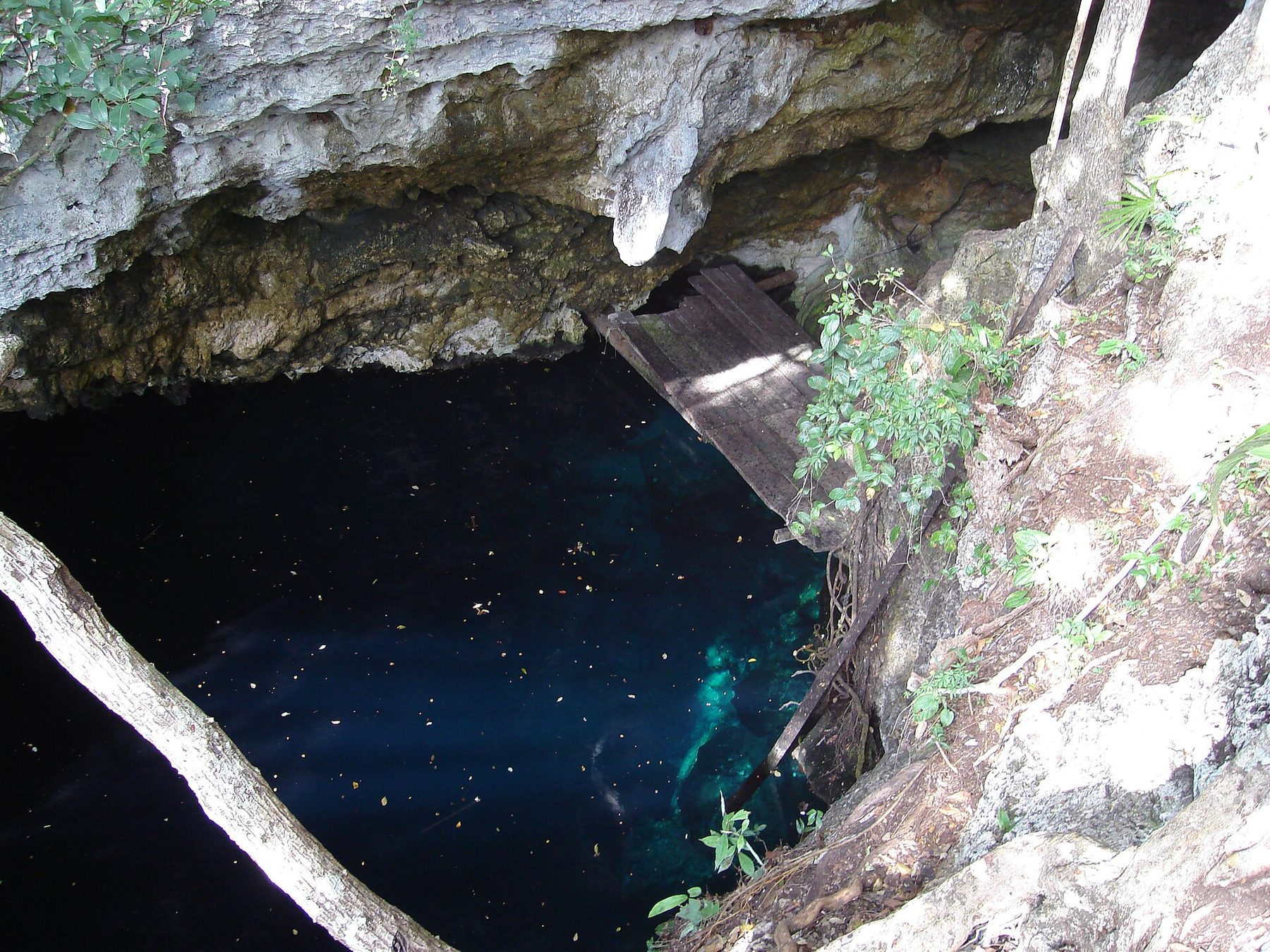
The Pit is the one people plan a trip around. Ko'ox Diving describes a one-tank dive to about 100 feet, 30 m, in 25C water, suitable for advanced divers, 22 km north of Tulum and 54 km south of Playa del Carmen. 4 Its own page credits the site's reputation to a 100-foot column of light falling through the halocline and the gas cloud below it. 4 The shop pairs it with two Dos Ojos dives as a three-cenote day. 4
Tajma-Ha sits in between. Seth Dive Mexico gives it a 15 m cavern zone, 24 to 25C water, visibility past 80 m, and an intermediate rating that stays open to Open Water divers with steady buoyancy, because the passages run close to speleothem formations millions of years old. 14 That is the site where finning technique earns its keep. Book it on day two, once the trim is back. Settle into a base first with where to stay in Tulum.
All four sit inside an hour of the same base, which is what makes a two-cenote day possible without much driving. The Tulum travel guide prices the ruins and the non-diving days for whenever divers surface.
Angelita: the cloud at 30 metres
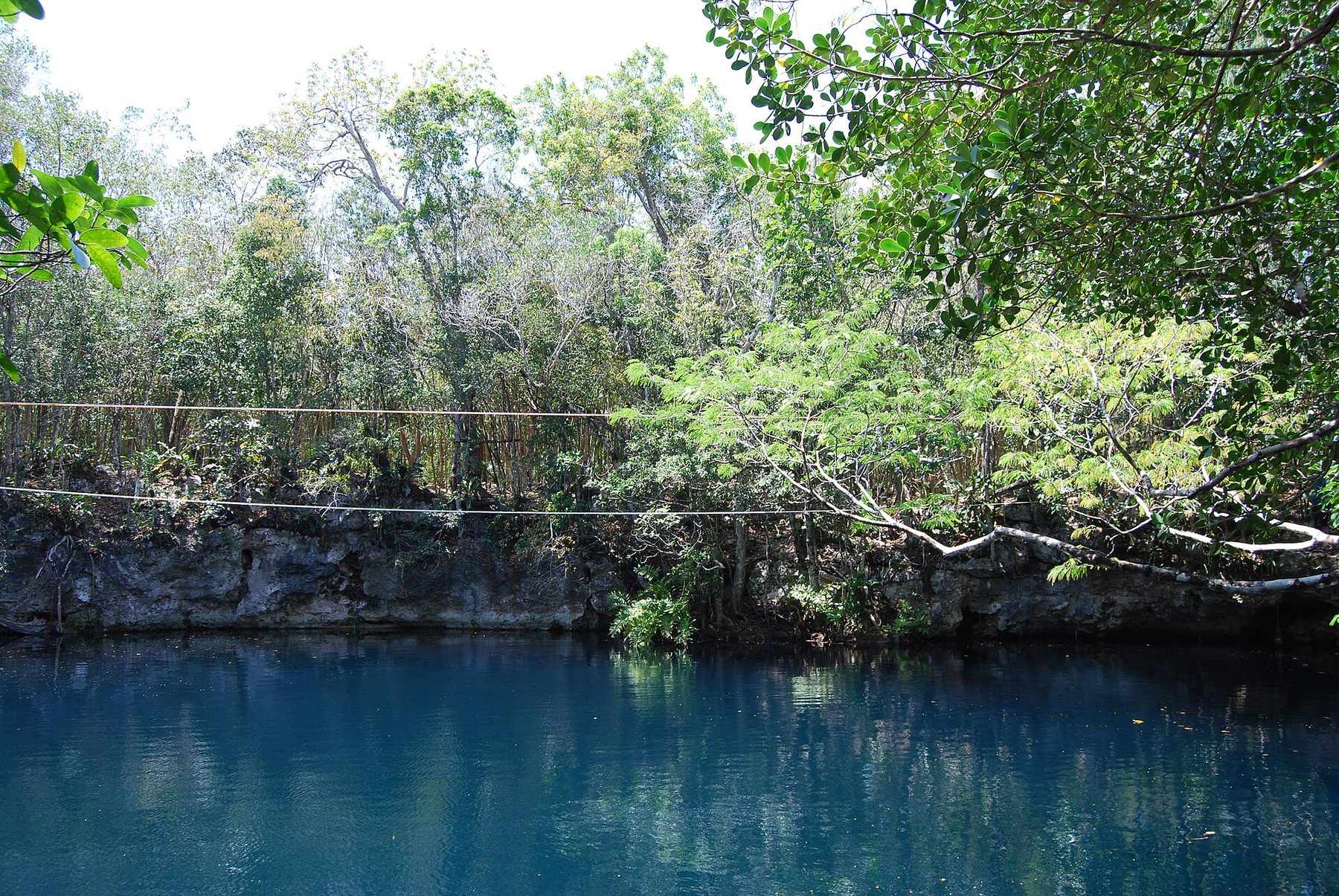
Angelita is the photograph that sells cenote diving, and it is a deep dive. Seth Dive Mexico gives a maximum dive depth of 35 m and more, in a cenote past 60 m deep, with a hydrogen sulfide cloud at about 30 m and divers dropping to 33 to 35 m to see the submerged forest standing below it. 6 Water runs 24 to 26C above the cloud and 22C below. 6
The cloud itself is a byproduct of decomposing organic matter, and the operator describes a small amount entering a mask as a passing sulfur smell. 6 The depth is the thing to respect, which is why the entry bar here is Advanced Open Water with logged deep-dive experience rather than a plain Open Water card. 6 The site sits about 15 minutes south of Tulum, and the private tour starts at $185 a person with gear. 6
Pair a cenote morning with an afternoon on the highway: the bull shark dive at Playa del Carmen is seasonal and an hour away, so divers who want big animals alongside geology get both inside one week.
How much does cavern and cave certification cost?
One card or the whole ladder. Tulum Diving Center publishes $870 for the cavern specialty; Under The Jungle prices zero to Full Cave at about $3,000 to $4,000.
The Cavern Diving Specialty Course at Tulum Diving Center is $870 a diver, and $783 each when two or more book together on the 10% multi-diver discount. 7 That buys three days, a minimum of four cavern dives and sidemount equipment, on top of the Advanced Open Water and Sidemount cards you bring. 7
One thing to fix early: full cave certification in the Riviera Maya is a TDI credential. PADI's own catalogue stops at Cavern Diver for this environment. 10 Zen Diving, ProTec and Tulum Diving Center all certify full cave divers under TDI standards instead. 5, 9, 7
| Course | Days | Rate, MXN | Total, MXN | Total, USD |
|---|---|---|---|---|
| PADI Advanced Open Water | 3 average | 10,000 flat | 10,000 | 580 |
| TDI Cavern | 5 minimum | 5,600 a day | 28,000 | 1,624 |
| TDI Intro to Caves | 3 | 5,600 a day | 16,800 | 974 |
| TDI Full Cave | 4 minimum | 5,600 a day | 22,400 | 1,299 |
| Advanced Open Water to Full Cave | 15 minimum | - | 77,200 | 4,477 |
Totals multiply the operator's published day rate by its published day minimum: 5,600 x 5, 5,600 x 3 and 5,600 x 4. Instructor, cenote entrance fees, transport, snacks and water are inside the rate. Dollars convert at 17.2454 pesos per dollar for 18 September 2026. Zen Diving prices PADI Open Water at 12,000 pesos, about $696, for divers starting from zero.
Table view: Advanced Open Water to Full Cave, one operator's day rates
| Item | Value (MXN) | Share |
|---|---|---|
| TDI Cavern, 5 days | 28,000 MXN | 36% |
| TDI Full Cave, 4 days | 22,400 MXN | 29% |
| TDI Intro to Caves, 3 days | 16,800 MXN | 22% |
| Advanced Open Water, flat | 10,000 MXN | 13% |
Cavern is the longest and priciest rung, at more than a third of the total. A diver who only wants the daylight zone stops after it and keeps about 39,200 pesos. Source: 5
Under The Jungle prices the same journey as one block: about 14 days from zero technical experience to Full Cave, charged per day, 10% more for private students. 8 Zen's day rates multiply out to USD 4,477 at its published minimums; Under The Jungle quotes USD 3,000 to USD 4,000 for the same 14 days. Budget toward the higher figure and treat anything under it as a good week.
ProTec Dive Centers runs the same three rungs, Cavern Diver, Intro to Cave Diver, then Cave Diver, and prices training on a daily rate. 9 Its dollar figures live in a downloadable price list, so ask for them in writing. 15
- Inside the daily rate at ProTec: transport from the dive centre to the site and back, cenote entrance fees, rental tanks, and breathing gases including air, EAN32 and the oxygen and Sofnolime a rebreather student burns. 15
- Outside it: manuals, certification cards, helium-based mixes, boat fees, rebreather rental, lunch and drinks. 15
- Outside every operator's rate: the Advanced Open Water card the cavern course wants first, and the Sidemount card Tulum Diving Center wants alongside it. 10, 7
- Worth pricing against a year of diving at home: how much a year of diving costs works through the annual math.
Who runs each cenote, and who takes the fee
Parque Dos Ojos states on its own site that the park is run by local Maya communities as a responsible ecotourism project, protecting one of Mexico's most biodiverse regions while sharing it with visitors. 16 It sits at kilometre 244 on the Tulum to Playa del Carmen highway, about 20 minutes north of Tulum. 16 The gate fee goes to the park; the dive package goes to your operator. Two separate transactions, often on the same morning.
This is a living region with a living language. Mexico's 2020 census counted 774,755 speakers of Maayat'aan, Yucatec Maya, across the peninsula, including the municipalities these cenotes sit in. 17
The cave systems carry Maya names because Maya communities named them and still hold them. Sac Actun, white cave, is the one the park puts at more than 376 km of mapped galleries and calls the longest mapped underwater cave system in the world. 16 Dos Ojos is a sub-system inside it, and Seth Dive Mexico surveys that sub-system alone at more than 82 km. 1
| Cenote | Fee, MXN | Fee, USD | Who collects it |
|---|---|---|---|
| Dos Ojos, standard tour | 640 | 37 | Parque Dos Ojos, run by local Maya communities |
| Dos Ojos, combination tour with Nicte-Ha and Jaguar | 960 | 56 | Parque Dos Ojos, launch promotion |
| Calavera, divers and swimmers | 250 | 14 | A single owner and attendant on site, cash |
| Calavera, camera beyond a phone | 200 extra | 12 | Same, charged at the gate |
| Car Wash (Aktun-Ha), divers | 100-120 | 6-7 | Site attendant, Highway 109 toward Coba |
Dollars convert at 17.2454 pesos per dollar for 18 September 2026. Parque Dos Ojos labels its own figures a site-launch promotion, so confirm the standing rate at the gate. The Calavera and Car Wash fees come from travel directories rather than the sites' own pages; Car Wash reports 40 to 50 pesos for swimmers and snorkelers against 100 to 120 for divers.
The park's own visit rules are short and worth following before anyone asks. Biodegradable sunscreen only, because a cenote is a fragile ecosystem. A shower before you enter. Non-slip footwear on the wooden stairways. A life jacket, included, for anyone uncertified. Quiet in the cave sections, for the bats, the blind fish and the endemic birds that live there. 16 For the rest of the country, the Mexico travel guide covers regional routes and your first day.
Your first cavern day, in order
A 6 a.m. alarm, an 8 a.m. pickup, two dives in the daylight zone, and the two phone numbers that belong in your notes before any of it.
Six moves turn a cenote day from a booking into a dive. The order matters more than the budget, because two of them have to happen before you leave home: the logged-dive count that qualifies you, and the two phone numbers that cover the whole corridor. 3, 19
Clear the recency rule
Under The Jungle wants 20 logged dives and a dive inside the past six months. 3 Log book, or a refresher dive on arrival day.
One last piece of planning discipline. Cenote dives are shallow and long, which makes them easy to stack, and The Pit at 30 m alongside Angelita at 35 m puts two deep dives in one region. 4, 6 Space the deep days out, keep the last dive well clear of your flight home, and leave the third dive on the table when the first two were good ones.
Frequently asked questions
What is the difference between cavern and cave diving?
Daylight. Under The Jungle defines a cavern dive as one where daylight stays visible throughout and divers stay inside 200 feet of a surface with breathable air, next to a continuous guideline. Cave diving goes past that limit, and every operator here restricts it to divers holding their own cave certification. Ko'ox Diving labels the category "for Cave Certified Only". 3, 4
How deep is a cenote dive?
Most cavern dives run 8 to 18 m. Dos Ojos holds at 8 to 10 m, Tajma-Ha reaches about 15 m, and the deeper sites go to 30 to 40 m: The Pit at about 30 m and Angelita at 33 to 35 m in a cenote past 60 m deep. Visibility runs 50 to 100 m and beyond at all of them. 2, 1, 14, 4, 6
Can an Open Water diver dive The Pit?
Ko'ox Diving describes The Pit as a one-tank dive to about 30 m in 25C water, suitable for advanced divers, so Advanced Open Water is the card to bring. Dos Ojos and Tajma-Ha are the Open Water sites. Advanced Open Water is five dives, two required plus three electives, and Ko'ox sells it from Tulum for $584. 4, 11, 1, 14
What is the Angelita halocline?
The layer people photograph at Angelita is a hydrogen sulfide cloud at about 30 m, a byproduct of decomposing organic matter, with a submerged forest standing below it. A halocline is the separate optical boundary where fresh water meets salt, which Ko'ox names as part of The Pit's appeal. Angelita asks for Advanced Open Water with logged deep-dive experience. 6, 4
How much is a guided cenote dive in Tulum?
At Zen Diving, one cavern dive is 3,000 pesos (about $174); two average out to 1,800 pesos each, and three to about 1,667 each, because the instructor and transport cost spreads across more tanks. Ko'ox and Seth Dive price by the package instead: $249 for two cenote dives from Tulum, or $185 a person for Seth's private tour. 5, 4, 6, 12
Do cenote entrance fees come on top of the dive price?
It depends on the operator, so ask. Zen Diving and ProTec include cenote entrance fees in their rates. Under The Jungle excludes them so clients pick their own sites. Gate fees themselves range from 100 to 120 pesos for divers at Car Wash to 640 pesos for the standard Dos Ojos tour. 5, 15, 3, 13, 16
Which agency certifies cave divers in Mexico?
TDI, in practice. PADI's course catalogue stops at the Cavern Diver specialty for this environment, which itself asks for Advanced Open Water and age 18. Zen Diving, ProTec and Tulum Diving Center all run their full cave training under TDI standards. Zen's ladder is 5,600 pesos a day, with five-day, three-day and four-day minimums for Cavern, Intro to Caves and Full Cave. 10, 5, 9, 7
Sources & review date
Researched 2026-09-25. Prepared from primary sources, with a separate independent source review. Numbered notes in the text point to the sources below. Prices, entry rules and schedules change; use the linked authority for your dates.
- 1Cenote Dos Ojos diving Seth Dive Mexico · Accessed 2026-09-25 · Primary source
- 2Cenote diving FAQ Seth Dive Mexico · Accessed 2026-09-25 · Primary source
- 3Cavern diving: prerequisites, zone definition and inclusions Under The Jungle · Accessed 2026-09-25 · Primary source
- 4The Pit cenote dive, prices and cave-dive categories Ko'ox Diving · Accessed 2026-09-25 · Primary source
- 5Cenote diving prices: tours and courses Zen Diving, Tulum · Accessed 2026-09-25 · Primary source
- 6Cenote Angelita diving Seth Dive Mexico · Accessed 2026-09-25 · Primary source
- 7Cavern Diving Specialty Course Tulum Diving Center · Accessed 2026-09-25 · Primary source
- 8Get started cave diving Under The Jungle · Accessed 2026-09-25 · Primary source
- 9Cave and cavern diving courses ProTec Dive Centers · Accessed 2026-09-25 · Primary source
- 10Cavern Diver specialty course PADI · Accessed 2026-09-25 · Primary source
- 11Advanced Open Water Diver course PADI · Accessed 2026-09-25 · Primary source
- 12H.10 foreign exchange rates, week of 14 to 18 September 2026 Federal Reserve Board · Accessed 2026-09-25 · Primary source
- 13Cenote Car Wash (Aktun-Ha): fees and access todotulum.com · Accessed 2026-09-25
- 14Cenote Tajma-Ha diving Seth Dive Mexico · Accessed 2026-09-25 · Primary source
- 15Training price list: what the daily rate includes ProTec Dive Centers · Accessed 2026-09-25 · Primary source
- 16Parque Dos Ojos: operator, tours, prices and visit rules Parque Dos Ojos · Accessed 2026-09-25 · Primary source
- 17Lengua del mes: Maayat'aan (maya) INALI, Instituto Nacional de Lenguas Indigenas · Accessed 2026-09-25 · Primary source
- 18Cenote Calavera: entrance fee and camera charge This Rare Earth · Accessed 2026-09-25
- 19Playa del Carmen recompression chamber SSS Recompression Chamber Network · Accessed 2026-09-25 · Primary source
- 20Contact and emergency hotline Divers Alert Network · Accessed 2026-09-25 · Primary source